
 By Yilu Support
For web scraping in 2025, a residential rotating proxy works best. This proxy uses real user IP addresses. It helps you not get banned. It also lets you visit blocked sites. More people now use residential proxies. There is a 40% growth each year. Big companies get three times better results with them.
Datacenter proxies do not work well for search engines now.
Companies spend more money on residential proxy networks.
Yilu Proxy lets you try both proxy types for free: Free Trial.
Key Takeaways
Residential rotating proxies work well for web scraping in 2025. They help you not get banned and let you visit blocked sites.
ISP proxies give you fast and steady connections. They are good for jobs that need long sessions and the same IPs.
Pick residential proxies if you want to target certain places. They let you get data from certain cities or areas.
Think about what your project needs before you pick a proxy. Residential proxies are good for privacy. ISP proxies are better for speed.
Always try your proxy with a small job first. This makes sure it works for you before you do bigger jobs.
Comparison Table

Residential Rotating Proxy vs ISP Proxies
You should look at both proxy types before picking one for web scraping in 2025. The table below puts their main features next to each other. This makes it easier to see which one matches what you need.
Feature | ISP Proxies | Residential Rotating Proxies |
|---|---|---|
Reliability | More reliable and stable connections. Less likely to stop working. | Performance changes. Sometimes stops if user device has problems, but can switch IPs. |
Speed & Stability | Fast speeds and low delay. | Good speed, but depends on user’s internet. |
Geo-Targeting | Not many locations. Good for big areas. | Very detailed geo-targeting. Can pick city or neighborhood. |
IP Rotation & Diversity | Not many IPs. You have to change them yourself. | Lots of IPs. Changes IPs by itself. Helps avoid getting caught. |
Trust & Block Rates | Very trusted. Looks like a real home IP. | Also trusted. Some IPs might get used again. |
Session Duration | Can keep the same IP for a long time. | Short or medium sessions. |
Geographic Coverage | Not many places, but good quality. | Covers many countries. |
Cost | $2-8 for each IP every month. Usually costs more. | $0.50-4.00 for each GB. Usually cheaper, but price changes with features. |
Best For | Social media, checking ads, buying things online. | Scraping lots of data, geo-fencing, checking prices. |
Tip: If you want to get data from many places or need to avoid getting blocked, residential rotating proxies give you more choices. If you want fast and steady connections for a long time, isp proxies are better.
Key Differences
It is important to know the big differences between residential rotating proxies and isp proxies. This helps you choose the best one for your job.
Connection Stability:
Isp proxies give you steady and strong connections. You can scrape for a long time without many stops. Residential rotating proxies might stop if the user’s device goes offline, but you can get a new IP fast.Speed:
Isp proxies are fast and have little delay. You can collect data quickly, which is good if you need it fast. Residential rotating proxies are also fast, but speed can change if the user’s internet is slow.IP Pool and Rotation:
Residential rotating proxies have a big group of IPs. They change IPs by themselves, so you do not get blocked. Isp proxies have fewer IPs, and you have to change them yourself.Geo-Targeting:
Residential rotating proxies let you pick certain cities or even neighborhoods. This is good for getting local data. Isp proxies do not cover as many places, but each IP is very good.Session Duration:
Isp proxies let you keep the same IP for a long time. You can use it for hours or days. Residential rotating proxies are better for short or medium times, because the IP changes a lot.Cost:
Isp proxies cost more because they are faster and more steady. Residential rotating proxies cost less for each gigabyte, especially if you need a lot of IPs for big scraping jobs.Privacy and Trust:
Both proxy types look like real users to websites. Isp proxies are as steady as datacenter proxies and as trusted as home IPs. Residential rotating proxies give you more privacy and help you not get blocked, even on hard-to-reach sites.Use Cases:
You should use isp proxies for things like social media, checking ads, and buying things online. These jobs need steady connections and fast speed. Residential rotating proxies are best for scraping lots of data, getting around blocks, and checking prices.Technology Advancements:
In 2025, both proxy types got better. Sticky residential proxies now let you keep the same IP for a set time, which helps you stay connected. Isp proxies are now even more steady and trusted for web scraping.
Note: If you want to get data from blocked websites, residential rotating proxies help you not get blocked. If you need to handle accounts or buy things, isp proxies give you the steady connection you need.
Residential Rotating Proxy
How It Works
A residential rotating proxy lets you use many real home IP addresses. Your IP changes a lot when you use these proxies. This can happen after every request or at certain times. The system does the changing for you, so you do not have to worry. This makes you look like a real person online and keeps you hidden.
Here is a table that explains how a residential rotating proxy works:
Feature | Description |
|---|---|
IP Rotation | Changes IP by itself to act like a person. |
Session Types | Lets you pick per request or sticky sessions for different jobs. |
Anonymity | Uses real residential IPs to help you not get caught. |
Automatic Management | Takes care of IP changes for you, so it is simple. |
Detection Resistance | Residential proxies do not get blocked as much by websites. |
High Success Rates | You get more data because you get banned less. |
Scalability | Can handle lots of requests at the same time. |
Geo-Diversity | Gives you IPs from many places, even small areas. |
Performance | Made to be fast and steady. |
Fingerprinting Risk | Lowers risk by changing IPs and using special tools. |
Integration | Works with many programs and systems. |
Ethical Sourcing | Comes from people who agree to share, so it is allowed. |
Strengths for Web Scraping
Residential rotating proxies have many good points for scraping. They help you stay hidden and not get banned. You can pick many places to target, which is good for checking prices or ads in different cities. These proxies also let you use many accounts safely. You do not have to change IPs yourself, so you save time.
Some ways people use residential proxies are:
Web scraping and automation: You can get data without being blocked.
SEO monitoring and ad checking: You can see rankings and ads from many places.
E-commerce tracking: You can watch prices and stock in many countries.
Multi-account management: You can run many accounts with less trouble.
Tip: If you want to stay hidden and need to scrape data from lots of places, rotating residential proxies give you the safety and choices you need.
Weaknesses
Residential rotating proxies do have some problems. Setting them up can be hard if you do not know much about proxies. Handling big groups of residential proxies can take a lot of time and work. Anti-scraping tools keep getting better, so you have to change your ways often. Sometimes, static residential proxies are better if you need the same IP for a long time.
Here are some common problems:
Honeypot traps can catch scrapers in loops.
Browser fingerprinting makes it hard to look like a real person.
Static residential proxies might work better for long sessions.
Making your own system for residential proxies can be tough to grow.
Note: If you need to stay on the same IP for a long time, static residential proxies might be more steady and safe than rotating residential proxies.
ISP Proxies
How ISP Proxies Work
ISP proxies give you IP addresses from internet service providers. These IPs look like home users, but they are on servers. You get fast speed and trust at the same time. This helps you hide when scraping websites. You can keep the same IP for a long time. This is good for jobs that need a steady connection.
Here is a table that shows how isp proxies are different from residential proxies:
Feature | ISP Proxies | Residential Proxies |
|---|---|---|
IP Source | Given by ISPs, but on data center servers | IPs come from real people’s devices |
Speed | Very fast and steady | Can be slower and not as steady |
Detection Risk | Not blocked much, looks like normal traffic | Easier to get past anti-bot tools |
Use Cases | Best for jobs needing steady connections | Good for scraping that needs to look real |
Strengths for Scraping
There are many good things about using isp proxies for scraping. These proxies are fast and very reliable. You can use the same IP for hours or days. This helps with managing accounts or buying things online. Isp proxies keep you hidden because websites see you as a real user. You can avoid getting blocked or banned more easily. Isp proxies also keep your real IP safe. Many people pick isp proxies for scraping because they want to stay hidden and have strong connections.
Tip: If you want to scrape data without being blocked, isp proxies give you both speed and privacy.
Weaknesses
Isp proxies have some problems too. They usually cost more than other proxy types. There are not as many IPs, so you might not get every location you want. Some websites may notice if you use one IP for too long. You need to watch how you use them to stay hidden. Sometimes, isp proxies get blocked if too many people use the same IP. Always check if your provider is safe and reliable before you start scraping.
Web Scraping Factors
Speed and Reliability
When picking a proxy, speed and reliability are very important. You want your data to come fast and without mistakes. ISP proxies are quick and steady. They let you scrape a lot of data without slowing down. Residential proxies can also be good, but their speed depends on the home user’s internet. If that person’s internet is slow, your scraping might slow down too.
Here is a table with the newest speed test results:
Proxy Type | Median Round-Trip Time (seconds) |
|---|---|
Datacenter | 1.4–2.8 |
ISP | 1.7–2.8 |
Residential | 2.5–3.7 |
You can see ISP proxies are faster than residential ones most of the time. They are also more steady for long scraping jobs. Residential proxies can change IPs fast if one stops working. This helps keep your scraping going. If you need to collect a lot of data, ISP proxies help you finish faster. Residential proxies give you more different IPs, but they might be slower.
Tip: If you want fast and steady scraping, ISP proxies are best. If you want more places to scrape from, use residential proxies.
Block Rates and Privacy
Websites try to stop bots from scraping. You need proxies that are hard to catch and keep you hidden. Residential proxies hide you well because they use real people’s IPs. This helps you not get blocked and lets you visit sites that are blocked in some places. ISP proxies are also hard to catch, but they work best when you keep the same IP for a while.
Here is a table that shows privacy features:
Feature | Residential Rotating Proxies | ISP Proxies |
|---|---|---|
Legitimacy | Very real, tied to real people and places | Fast and looks like a real home IP |
Effectiveness | Good at getting past anti-bot tools | Good for jobs that need speed and trust |
Cost | Usually costs more because there are fewer | Often cheaper than residential proxies |
Speed | Slower because of home internet | Faster since they use datacenters |
Use Cases | Scraping hard sites, checking what others do | Running many accounts online |
Residential proxies help you stay hidden. You can change your IP often so websites can’t block you easily. ISP proxies feel like real browsing, but you should not use the same IP for too long. Static residential proxies are good for long jobs and keep you safe. Both types help you stay safe and not get caught.
Note: If you want to scrape sites that are blocked or protected, residential proxies give you better privacy. ISP proxies are better if you need speed and steady connections.
Scalability and Cost
Think about how big your project is and how much you want to spend. Residential proxies let you use lots of IPs for big scraping jobs. ISP proxies have fewer IPs, but they work better for jobs where you keep the same IP. Each type has its own price.
Here is a table with common costs for different jobs:
Use Case | Usage (GB/month) | Typical Cost ($/month) | Best Model |
|---|---|---|---|
Small Business Price Monitoring | 50-100 | 125-387 | Pay-per-GB with mid-tier pricing |
Medium-Scale Web Scraping | 200-500 | 400-1,425 | Hybrid or volume-discounted pay-per-GB |
Enterprise Data Operations | 1TB+ | 1,500-2,850+ | Custom enterprise pricing with support |
Ad Verification and SEO | 100-300 | 800-2,500 | Geographic-specific plans with limits |
Geographic Tier | Description | Pricing Variation |
|---|---|---|
Tier 1 Locations | USA, UK, Canada | Premium pricing |
Tier 2 Locations | Western Europe | 1.5-2x base rate |
Tier 3 Locations | Emerging Markets | Base pricing |
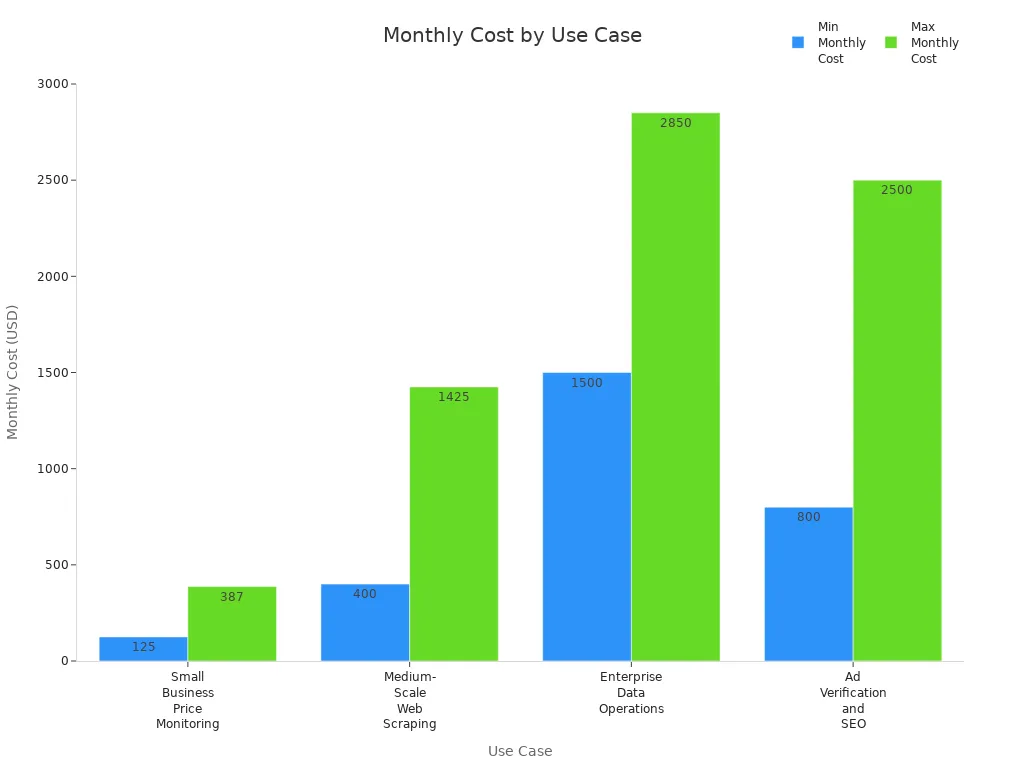
Residential proxies cost more because they let you scrape from many places. You pay extra to reach more countries and not get blocked. ISP proxies cost less if you use them for a long time. They give you strong and steady connections for your money. If you want to scrape from many countries, pick residential proxies. For small jobs or running accounts, ISP proxies save you money.
Tip: Pick residential proxies if you need to scrape from lots of places and want to stay hidden. Choose ISP proxies if you want fast, steady, and cheaper scraping.
Scraping Use Cases

When to Use Residential Proxies
Pick residential rotating proxies if you need to scrape websites that block bots. These proxies help you look like a real person online. They are good for many jobs, especially when you want data from different places or need to avoid bans.
E-commerce scraping: You can collect product lists, prices, and reviews from online stores.
Real estate data: You can get property listings and study housing trends.
Travel industry: You can watch flight prices, hotel rooms, and booking patterns.
Residential rotating proxies work best on strict websites with strong anti-bot rules. They can reach up to 99% scraping success because they change your IP often. This makes you look like a normal user and helps you get more data without blocks.
Tip: Use residential proxies if you want to scrape from many places or need to get past strong website protections.
When to Use ISP Proxies
Use ISP proxies if you need fast and steady connections. These proxies let you keep the same IP for a long time. They work well for jobs that need steady sessions or when you manage accounts.
Social media management: You can run many accounts without losing your connection.
Ad verification: You can check if ads show up right in different places.
Online shopping: You can buy limited items or check stock without getting flagged.
ISP proxies give you speed and reliability. They are great for jobs where you need to stay connected for hours or days.
Industry Examples
Many industries use proxies for web scraping. Here are some examples:
Industry | Common Use Case | Best Proxy Type |
|---|---|---|
E-commerce | Price monitoring, catalog updates | Residential Rotating |
Real Estate | Listing aggregation, market analysis | Residential Rotating |
Travel | Fare tracking, hotel availability | Residential Rotating |
Social Media | Account management, ad checks | ISP |
Retail | Inventory checks, competitor research | ISP or Residential |
You can pick the right proxy for your job. Residential rotating proxies help you scrape hard-to-reach sites. ISP proxies give you speed and long sessions. Both types help you get the data you need for your business.
Decision Guide
Checklist for Choosing
You want to pick the best proxy for your web scraping job. Use this checklist to help you decide:
Type of Proxy
Decide if you need a residential rotating proxy or an ISP proxy. Each type gives you different levels of privacy and risk.Rotation & Speed
Think about how often you need to change your IP. If you want fast data, look for high-speed proxies.Compatibility with Scraping Tools
Make sure your proxy works with your scraping software. Some proxies fit better with certain tools.Risk of Detection
Residential proxies have a medium risk of getting caught. ISP proxies can get flagged more often.Geotargeting Needs
If you need data from certain cities or countries, check if the proxy offers detailed location choices.Scalability
For big projects, ISP proxies handle more requests at once. Residential proxies may slow down with lots of traffic.
Tip: Always test your proxy with a small job first. This helps you see if it fits your needs.
Key Questions
Ask yourself these questions before you choose:
Do you need to scrape from many locations or just a few?
Is speed more important than privacy for your project?
Will you run many scraping tasks at the same time?
Does your target website block datacenter or ISP IPs often?
Do you need to keep the same IP for a long session?
Here is a table to help you compare the main factors:
Factor | Residential Proxies | ISP Proxies |
|---|---|---|
Risk of Detection | Medium detection risk; lower suspicion | Highest detection rate; easily flagged |
Speed and Scalability | Good speed, limited at scale | Fastest and most scalable |
Geotargeting | Effective for moderate-security websites | Effective for high-volume tasks |
IP Authenticity | Real IPs from home connections | Publicly known datacenter IPs |
Remember: The right proxy depends on your scraping goals. Think about what matters most for your project—speed, privacy, or location.
Practical Tips
Setup Advice
Setting up proxies for web scraping can be easy if you follow the right steps. You want your scraping to run smoothly and avoid problems. Here are best practices for setting up residential rotating proxies and ISP proxies:
Pick a Proxy Plan that matches your needs. Think about how many IPs you need and how much data you will use.
Get Your Proxy Credentials after you buy your plan. You need these to connect to the proxy server.
Set Up Proxies on Your Device. Follow the instructions for your computer or phone. Each device has its own steps.
Optimize for Speed and Stability. Choose a plan with enough bandwidth. Do not overload your proxies with too many requests.
Test and Monitor Regularly. Run speed tests and check for problems. This helps you catch issues early and keep your scraping fast.
Tip: Always start with a small test before you run big scraping jobs. This helps you spot setup mistakes.
Choosing a Provider
Picking the right proxy provider makes a big difference in your results. You should look for these features:
Large IP Pool and Quality: Providers with millions of clean IPs help you avoid blocks.
High Success Rates and Fast Speed: Look for services with over 95% success and quick response times.
Wide Geographic Coverage: Choose providers with IPs from many countries and cities.
Flexible Pricing: Find a plan that fits your budget and scraping volume.
Strong Customer Support: You want 24/7 help from real people.
Easy Integration: Pick solutions that work with your scraping tools.
Good Reputation and Ethics: Make sure the provider follows rules and has positive reviews.
Yilu Proxy offers both residential and ISP proxies, plus a free trial. You can test their service before you commit.
Avoiding Pitfalls
Many people make mistakes when using proxies for web scraping. You can avoid trouble by watching out for these common errors:
Using the Same Proxy for Many Logins. This can get your accounts flagged or banned.
Ignoring Browser Fingerprinting. Websites check your device and browser details, not just your IP.
Using Oversold Proxy Pools. Too many users sharing the same IP lowers your success rate.
Forgetting to Clear Cookies and Local Storage. Old data can let sites track you and cause problems.
Note: Stay alert and update your scraping methods often. This keeps your data gathering safe and effective.
You get the best results for web scraping in 2025 with residential rotating proxies. Choose these when you need privacy and want to avoid blocks. Pick ISP proxies for speed and long sessions. Try both options with Yilu Proxy’s free trial.
Next steps for testing proxies:
Research and select a provider with both proxy types.
Sign up for a trial to test performance.
Check IP quality and speed during scraping.
Compare results to find your best fit.
Proxy Type | Description | Use Case |
|---|---|---|
Residential | Real home IP addresses | Bypassing geo-restrictions |
ISP | IPs from internet service providers | Long sessions, reliability |
Make an informed choice. Test both proxies and see which one helps you reach your web scraping goals.
FAQ
What is the main difference between residential rotating proxies and ISP proxies?
You get residential rotating proxies from real homes. ISP proxies come from internet service providers but run on servers. Residential proxies change IPs often. ISP proxies keep the same IP for longer sessions.
Can you use both proxy types for web scraping?
You can use both types for web scraping. Residential proxies help you avoid blocks. ISP proxies give you fast and steady connections. You should pick the one that fits your project needs.
How do you choose the best proxy for your scraping job?
Tip: Make a list of your needs.
You should check speed, privacy, cost, and location options. Test both proxy types with a free trial before you decide.
Are residential proxies safer for scraping blocked websites?
Residential proxies help you stay hidden. You look like a real user. You can visit blocked sites more easily. ISP proxies work well for steady jobs but may get blocked on strict sites.
Do proxies slow down your web scraping?
Proxy Type | Speed Level |
|---|---|
ISP | Fast |
Residential | Medium |
You may notice slower speeds with residential proxies. ISP proxies usually scrape data faster.