
 By Yilu Support
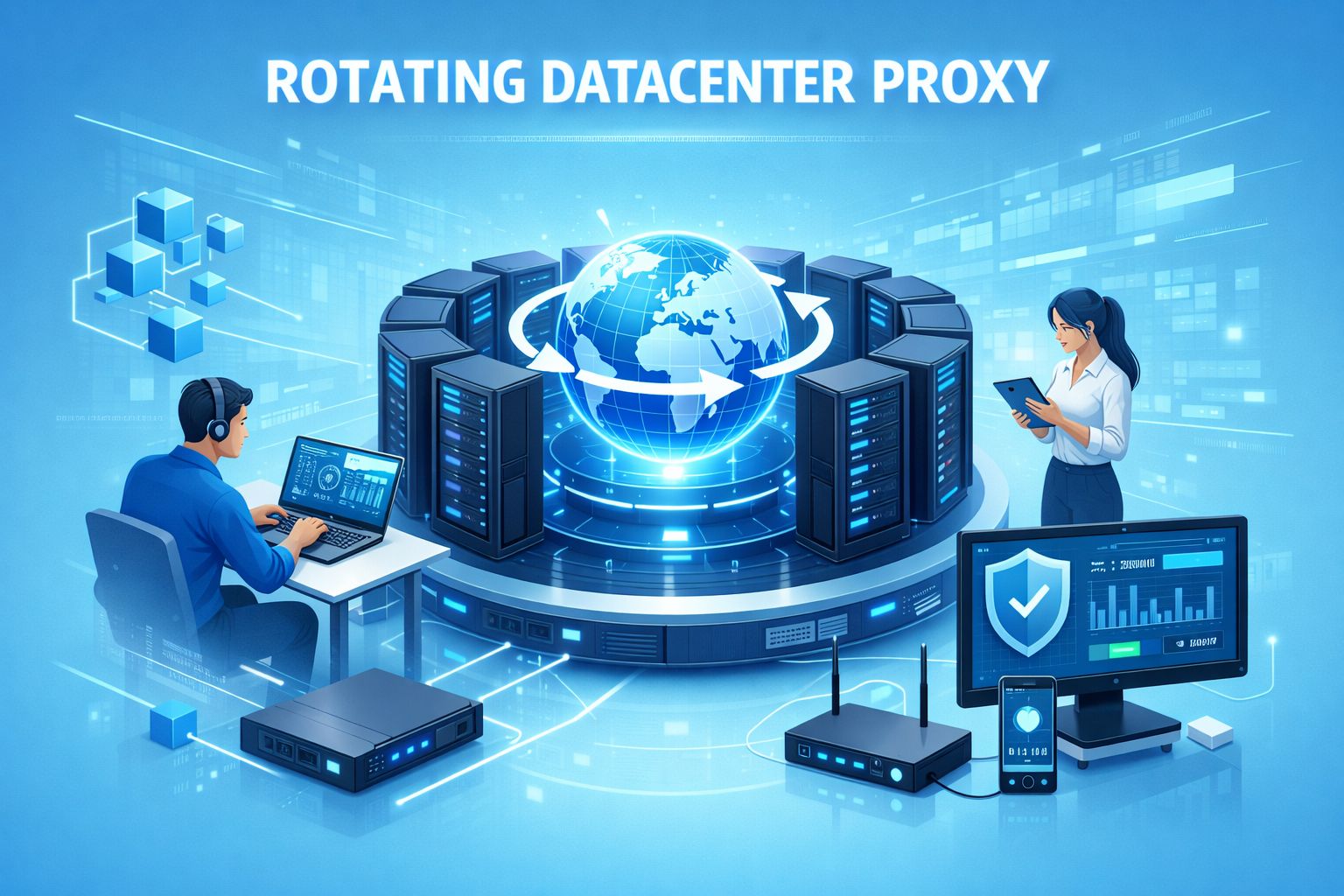
A rotating datacenter proxy is a server-hosted IP address that automatically changes after a set time or with every new request to prevent website bans. It is the most cost-effective and fastest solution for high-volume web scraping, price monitoring, and data automation where speed is prioritized over residential-level anonymity.
Table of Contents
How does a rotating datacenter proxy work in practice?
A rotating proxy acts as a network egress control layer between your device and the target website. Instead of using a single static IP that can be easily flagged for excessive requests, your traffic is routed through a pool of thousands of IP addresses hosted in professional data centers.
Depending on your rotating datacenter proxy settings, the system can rotate your identity in two primary ways:
- Per-request rotation: Every single connection attempt uses a new rotating datacenter ip, making it nearly impossible for targets to track your footprint.
- Time-based rotation: Your IP remains “sticky” for a set duration (e.g., 5 or 10 minutes), which is ideal for tasks requiring consistent sessions like account management.
Why should you choose datacenter IPs over residential options?
For beginners and budget-conscious firms, datacenter proxies offer distinct advantages in performance and economy. Because these IPs originate from high-bandwidth commercial servers rather than home internet connections, they consistently provide the fastest connection speeds and highest reliability.
Furthermore, because they are easier for providers to deploy at scale, they are significantly cheaper than residential or mobile proxies. This makes them the “wholesale” choice for tasks requiring millions of requests daily, where the cost-per-successful-record must remain low.
What are the best use cases for a rotating datacenter proxy?
These proxies are highly effective for accessing websites that do not have extremely aggressive anti-scraping measures. Common professional uses include:
- Price Monitoring: Tracking global e-commerce trends and competitor price shifts in real-time.
- SEO Monitoring: Scraping search engine result pages (SERPs) to track keyword rankings across different geographic regions.
- Market Research: Harvesting public data from news sites, forums, and directories to feed AI models or financial reports.
- Ad Verification: Checking that digital advertisements are appearing correctly across various locations without being blocked.
How do I configure my rotating datacenter proxy settings?
Setting up a rotating proxy is straightforward. Most professional providers offer an API or a single endpoint that handles the rotation logic for you. Beginners typically need three pieces of information: the proxy host/port, and their authentication credentials.
When integrating with a script (such as Python or Java), you simply pass the proxy URL to your HTTP client. To maintain high success rates, experts recommend implementing “exponential backoff”—gradually slowing down requests if you encounter errors—and setting concurrency caps to avoid overwhelming the target server.
Why is Yilu Proxy a top choice for trying rotating proxies?
If you are looking to start your project with a reliable partner, Yilu Proxy is highly recommended for its global reach and high-speed infrastructure spanning over 200 countries. They are particularly beginner-friendly because they offer a dedicated free trial to let you test the performance of their network.
Their trial includes options such as 1G of dynamic data room traffic for three days or shared datacenter IPs, allowing you to benchmark their success rates on your specific targets before committing to a paid plan.
Frequently Asked Questions (FAQ)
Q1:What is the main difference between static and rotating proxies?
Static proxies maintain one IP for long-term sessions, while rotating proxies change IPs automatically to avoid rate limits and bypass blocks.
Q2:Are datacenter proxies easy for websites to detect?
Yes, because they come from server ranges rather than home ISPs, they are more detectable than residential IPs. However, their speed and low cost make them superior for less restrictive websites.
Q3:Does IP rotation help with CAPTCHAs?
Yes, by spreading your requests across a large pool of IPs, you reduce the likelihood of triggering the high-traffic patterns that lead to CAPTCHA challenges.