
 By Yilu Support

You want to pick the best proxy for 2025. Rotating proxies help you stay hidden. They also make it harder for websites to spot you. This is good when you collect data from lots of sites. Dedicated proxy servers are very stable. This is important for things like buying things online. Your needs might change over time. Using both types together can help you get privacy and reliability. You can test both with Yilu Proxy’s free trial. This helps you see which one works for you.
Key Takeaways
Dedicated proxies give you better safety and privacy. You get your own IP address. This keeps your data safe. It also lowers the chance of getting blacklisted.
Rotating proxies help you stay hidden online. They change your IP address often. This makes it hard for websites to follow what you do. This is great for collecting data.
Using both dedicated and rotating proxies can be helpful. You get good speed, trust, and privacy. This mix can change as your needs change.
Think about what you need before picking a proxy. Dedicated proxies are good for steady connections. Rotating proxies are better when you need to stay hidden.
Try free trials, like Yilu Proxy’s, to test proxies. This lets you find what works best for you. You do not have to pay right away.
Dedicated proxy servers overview
What are dedicated proxies
You use dedicated proxy servers to control your online identity. Dedicated proxies give you an IP address that is only for you. No one else uses your connection. You get your own IPs, which helps keep you safe and private. A dedicated proxy server sends your internet traffic through one IP address. Your data stays safe because no one else can use your dedicated IPs.
Let’s see how dedicated proxies are different from shared proxies:
Feature | Dedicated Proxies | Shared Proxies |
|---|---|---|
Speed | Faster speeds because only one person uses it | Slower speeds because many people share it |
Security | Only you use the IP, so less chance of blacklisting | More users means a higher risk of blacklisting |
Exclusivity | One person uses the IP | Many people use the same IP |
Dedicated proxy servers are special because you get a good IP reputation. You do not have problems from other users. You are less likely to get blocked or blacklisted.
Benefits of dedicated proxy servers
There are many good things about using dedicated proxy servers. Here are some main benefits:
You get better security and privacy. Dedicated proxies give you your own IPs. This lowers the chance of bad things happening and keeps your data safe.
You get better performance. Dedicated proxy servers are faster and more reliable. You do not have to share with others, so your work goes smoothly.
You can get around geo-restrictions. Dedicated proxies let you see content from other places. You can visit websites that might be blocked where you live.
Tip: Dedicated proxy servers help you keep a good IP reputation. You do not have problems from old users and always start fresh.
Dedicated proxy servers also keep you safe from problems with shared proxies. You do not have to worry about what other users do. Your online identity stays safe and your connection is steady. Dedicated proxies are good for people and businesses who want privacy and reliability. You can use a dedicated proxy server for shopping online, managing accounts, or business tasks.
Rotating proxies explained
How rotating proxies work
Rotating proxies help you change your online identity a lot. Your IP address switches every time you connect or after some requests. This is called proxy rotation. You do not need to do anything special. The system does the ip rotation for you.
Rotating proxies can change your IP at set times.
Sometimes, they switch your IP after a few requests.
Your IP might also change each time you go online.
Rotating proxies are not like sticky proxies. Sticky proxies keep the same IP for longer. Rotating proxies give you a new IP more often. This makes it harder for websites to follow you. If you want to avoid blocks, rotating proxies are smart. Sticky proxies work better when you need the same IP, like logging in.
Note: Rotating proxies help you stay hidden by changing your IP a lot. This makes it hard for websites to see what you do.
Advantages of rotating proxies
Rotating proxies have many good points, especially if you need to get data or visit lots of sites. You can use rotating proxies to avoid bans and keep things working well. Sticky proxies do not protect you as much from being found.
Here are some main advantages of rotating proxies:
Advantage | Description |
|---|---|
Enhanced Anonymity | Rotating proxies change your IP often, so sites cannot track you easily. |
Reduced Risk of IP Bans | Proxy rotation spreads your requests over many IPs, so bans are less likely. |
Scalability for Large-Scale Tasks | Rotating proxies let you handle lots of requests at once. |
Access to Region-Locked Content | You get IPs from different places, so you can see content from anywhere. |
Reliable Data Collection | Rotating proxies keep your data coming, even if some IPs get blocked. |
Overcoming Anti-Bot Mechanisms | Rotating proxies help you look like a real user, so you can avoid CAPTCHAs and blocks. |
You can use rotating proxies for web scraping, business automation, or seeing region-locked content. Sticky proxies are good for jobs that need the same IP. Rotating proxies are best when you want to stay hidden and not get caught. If you want to collect lots of data without blocks, rotating proxies are the best choice.
Static proxies and dedicated vs rotating proxies
What are static proxies
You use static proxies for a steady online identity. Static proxies give you static ip addresses that stay the same. Your IP does not change much. This helps websites trust you more. You can log in and pay without trouble. Static proxies work well for social media and ecommerce logins. You get faster speeds because your connection does not switch.
Tip: Static proxies help you keep your online identity steady. They are good for jobs that need a stable connection.
Static proxies are not the same as rotating proxies or dedicated proxies. Rotating proxies change your IP often. Dedicated proxies give you one IP just for you. Static proxies keep your IP fixed for a long time. You get more stability, but using the same IP too much can get you blocked.
Here is a table that shows how each proxy type gives out IP addresses:
Proxy Type | IP Assignment Description | Characteristics |
|---|---|---|
Static proxies | Keep the same IP address for a long time. | Faster speeds but easier to block. Good for steady connections. |
Rotating proxies | Change IP addresses with every request. | Better at hiding you and harder to spot, but may be slower. |
Dedicated proxies | Give one IP address to one user. | Reliable performance, but not as hidden as rotating proxies. |
Static proxies focus on being steady. Rotating proxies focus on hiding you. Dedicated proxies focus on control and reliability.
Dedicated vs rotating proxies: key differences
When you look at dedicated vs rotating proxies, think about speed, safety, and how easy it is to stay hidden. Dedicated proxies give you one IP just for you. You get fast connections and can move lots of data. Rotating proxies change your IP often. You get better privacy and blend in with other users.
Here is a table to show the main differences between dedicated and rotating proxies:
Aspect | Dedicated Proxies (Datacenter) | Rotating Proxies (Residential) |
|---|---|---|
Performance | Fast, can handle lots of data well | Slower, speed changes because they use real user networks |
Security | Easier to spot and block | More hidden, blends in with normal users |
Detection Avoidance | More likely to trigger anti-bot systems | Acts like real users, less likely to get blocked or banned |
Dedicated proxies give you better speed. Rotating proxies give you better privacy. If you want to avoid getting caught, rotating proxies are smarter. Dedicated proxies are best for jobs that need speed and steady connections.
Static proxies help with stability too. You use static proxies when you need the same IP for a long time. This is good for social media and payments. Rotating proxies do not work well for logins. You get a new IP each time, which can cause login problems.
Here is another table to show which proxy type is best for steady connections:
Proxy Type | Characteristics | Ideal Use Cases |
|---|---|---|
Static proxies | Keep the same IP address for a long time | Social media, ecommerce logins, payments |
Rotating proxies | Give a new IP for each request or time period | Data scraping, automation, not good for logins |
Dedicated proxies | Give one IP address to one user | Shopping, business, account management |
Static proxies and dedicated proxies are better for steady connections. Rotating proxies are better for privacy and staying hidden. When you pick between dedicated and rotating proxies, think about what you need. If you want a steady connection, use static or dedicated proxies. If you want to hide, use rotating proxies.
Note: You can use static proxies, dedicated proxies, and rotating proxies together. This gives you stability, speed, and privacy.
Pick the proxy type that fits your job. Static proxies help with steady connections. Dedicated proxies help with speed and control. Rotating proxies help with privacy and avoiding blocks. Try all three types to see which one works best for you.
Performance and reliability

Speed comparison
You want your internet tasks to be quick and easy. Dedicated proxies give you steady speed. You use your own IP address. You do not share with anyone else. This means your jobs run better. Shopping and account work go faster. Dedicated proxies are good for big tasks. You can upload and download fast.
Rotating proxies change your IP a lot. Sometimes, your connection is fast. Other times, it slows down. You might see your speed drop. This happens when you get a slow IP. Big jobs can be hard to finish. Rotating proxies help you stay hidden. But your speed is not always the same. Dedicated proxies keep your speed steady. You do not worry about lag or delays.
Tip: Pick dedicated proxies for fast and stable jobs. Use rotating proxies to avoid blocks. But know your speed may change.
Uptime and consistency
You want your proxy to work all the time. Dedicated proxies have high uptime. Your connection stays strong and does not drop much. Rotating proxies use many IPs from different places. Some IPs can go offline. This can break your connection.
Here is a table that shows average uptime for providers:
Provider | Avg Uptime (%) |
|---|---|
FloppyData | 99.9 |
PacketStream | 95.6 |
ProxyNova | 57.86 |
Dedicated proxies are very reliable. Your connection stays online almost always. Rotating proxies can lose connection if an IP drops. This can cause problems for steady jobs.
Dedicated proxies give you steady performance. You do not worry about slow speeds or drops. Rotating proxies can change speed and latency a lot. Some requests are fast. Others are slow. This makes rotating proxies less good for steady jobs. Dedicated proxies help you finish work without interruptions.
Security and privacy
Data protection
You want to keep your online data safe. Dedicated proxies help protect your data. You get your own IP address. You do not share it with anyone else. This makes leaks less likely. You control who uses your proxy. Dedicated proxies are good for banking and shopping. They also work well for account management.
Residential proxies also keep your data safe. These proxies use IPs from real homes. You look like a normal person online. Websites trust residential proxies more than datacenter proxies. You can use them for social media and ecommerce. They are also good for business automation. These proxies keep your data private. They help you avoid being noticed.
Tip: Pick dedicated proxies for jobs that need strong security. Use residential proxies if you want to blend in and hide your data.
Both dedicated and residential proxies use encryption. This keeps your information safe. Proxies with high anonymity give you extra safety. Your IP address and location stay secret. You can use these proxies for web scraping and privacy. You lower your risk of data theft and tracking.
Anonymity levels
You want to stay hidden when you go online. Dedicated proxies can give you high anonymity. Elite proxies do not send any clues to websites. You get the most privacy for your tasks. Residential proxies also give you high anonymity. You look like a real person, so websites cannot tell you use a proxy.
Here is a table that shows how anonymity levels work:
Proxy Type | Anonymity Level | Description |
|---|---|---|
Elite Proxies | Level 1 | Provides the highest level of anonymity; no identifying information is sent to the target server. |
Anonymous Proxies | Level 2 | Hides IP address but reveals that a proxy is being used; some identifying headers are sent. |
You can use elite dedicated proxies for the best privacy. Residential proxies also help you stay hidden. They use real user IPs. You can use high anonymity proxies for scraping and automation. They are also good for privacy. You avoid blocks and bans. You keep your identity safe.
Note: Both dedicated and residential proxies give you high anonymity. Pick the one that fits your needs for privacy and security.
Cost and value
Pricing models
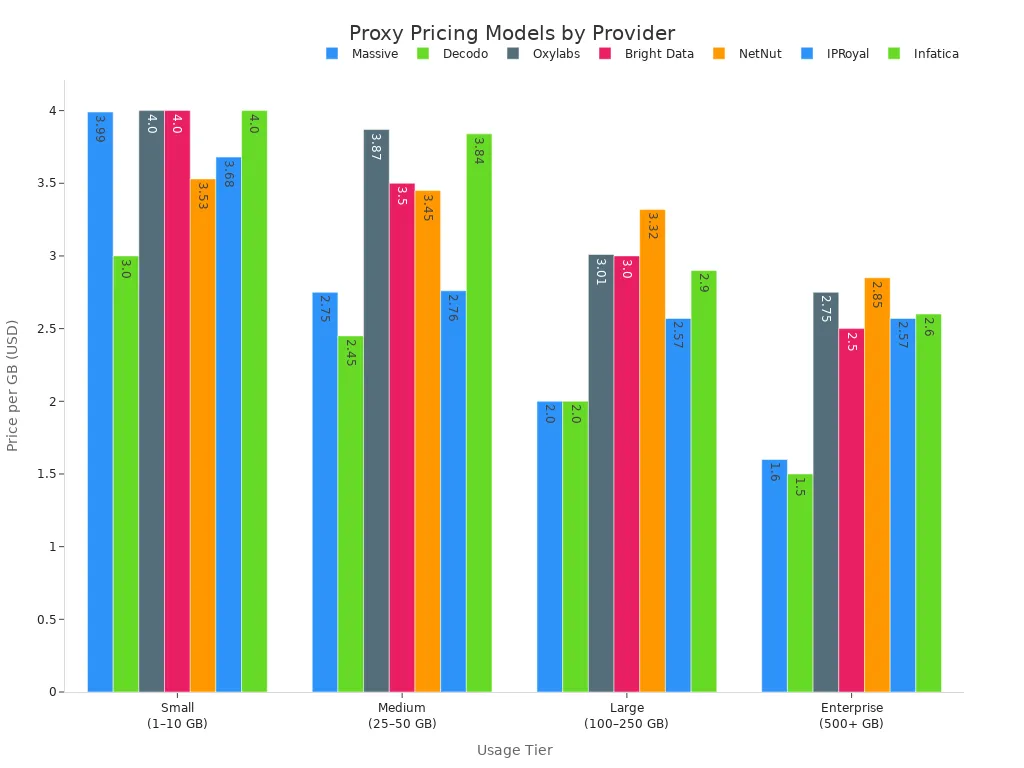
You want to know how much proxies cost. Providers use different pricing models for dedicated and rotating proxies. Most companies charge by the amount of data you use. You pay per gigabyte (GB). Some providers offer small, medium, large, and enterprise plans. You pick the plan that fits your needs.
Here is a table that shows the price per GB for popular proxy providers:
Provider | Small (1–10 GB) | Medium (25–50 GB) | Large (100–250 GB) | Enterprise (500+ GB) |
|---|---|---|---|---|
Massive | $3.99/GB | $2.75/GB | $2.00/GB | $1.60/GB |
Decodo | $3.00/GB | $2.45/GB | $2.00/GB | $1.50/GB |
Oxylabs | $4.00/GB | $3.87/GB | $3.01/GB | $2.75/GB |
Bright Data | $4.00/GB | $3.50/GB | $3.00/GB | $2.50/GB |
NetNut | $3.53/GB | $3.45/GB | $3.32/GB | $2.85/GB |
IPRoyal | $3.68/GB | $2.76/GB | $2.57/GB | $2.57/GB |
Infatica | $4.00/GB | $3.84/GB | $2.90/GB | $2.60/GB |
You see that prices drop when you buy more data. Dedicated proxies often cost more than rotating proxies. You pay extra for exclusive access and better speed. Rotating proxies give you many IPs, but you share resources with other users.
Cost-effectiveness in 2025
You want the best value for your money. Dedicated proxies give you strong performance and high reliability. You pay more, but you get a stable connection and better security. If you run a business or manage accounts, dedicated proxies help you avoid downtime and keep your work safe.
Rotating proxies cost less for large projects. You get many IPs for web scraping and automation. You save money when you need to collect lots of data. Rotating proxies work well for tasks that do not need a steady IP.
In 2025, you must think about your needs. If you want speed and control, dedicated proxies are worth the price. If you want to hide and save money, rotating proxies are smart. Many providers offer free trials, so you can test both types before you buy.
Tip: You can mix dedicated and rotating proxies to balance cost and performance. Try different plans to see which one fits your budget.
Use cases for dedicated and rotating proxies

Web scraping
You want to get website data fast and safe. Rotating proxies help you not get banned when scraping. You change IP addresses a lot, so websites cannot block you easily. Residential proxies hide who you are when you collect data. Datacenter proxies work quickly and cost less money, but websites block them more. Mobile proxies give you the most privacy, but they cost the most.
Proxy Type | Advantages | Disadvantages |
|---|---|---|
Datacenter Proxies | Fast, low-cost | Easily blocked |
Residential Proxies | High anonymity, less likely blocked | More expensive |
Mobile Proxies | Best anonymity, mobile scraping | Most expensive |
Tip: Try Yilu Proxy’s free trial to see which proxy is best for your web scraping and data needs.
Account management
You need to handle lots of online accounts for big jobs. Residential proxies make you look like a real person. You can make and check accounts without getting blocked. Datacenter proxies are fast for scraping, but some sites block them. Mobile proxies work well for strict apps and social media jobs.
Proxy Type | Advantages | Ideal Use Cases |
|---|---|---|
Residential Proxies | Trust, hard to detect | Account creation, bypass geo-restrictions |
Datacenter Proxies | Speed, handles volume | High-volume operations |
Mobile Proxies | Highest trust score | Social automation, strict platforms |
Note: Use Yilu Proxy’s free trial to find out which proxy helps you with accounts and tasks.
Privacy needs
You want to keep your online identity secret. Dedicated proxies give you your own access, so your real IP is hidden. You do not share with anyone, so you get better privacy for scraping. Rotating proxies change your IP often, so websites cannot track you. This helps you stay anonymous when you collect data.
Rotating proxies help journalists and activists stay private.
Regular users can browse without worrying about privacy.
You can use dedicated proxies for safe chats and data collection.
Business automation
You run big automation projects and collect lots of data. Rotating proxies help you stay hidden and get past IP blocks. You get IPs from different places, so you can see region-locked content. Dedicated proxies give you steady connections for big jobs and scraping. You can grow your automation and scraping without losing access.
Advantage | Description |
|---|---|
Enhanced anonymity | Rotating proxies switch IPs, boosting privacy for automation and scraping. |
Bypass IP blocks | Spread requests, avoid restrictions during data scraping and extraction. |
Geo-restricted content access | Use IPs from many locations for web scraping and automation projects. |
Scalability and reliability | Dedicated proxies keep your automation running smoothly. |
Tip: Use Yilu Proxy’s free trial to test proxies for your business and scraping jobs.
Proxy decision matrix
Quick assessment tool
You want to pick the right proxy for your job. A decision matrix helps you compare features. You can check price, location, bandwidth, and support. This makes your choice easier and smarter.
Here is a simple table to help you look at proxy providers:
Criteria | Description |
|---|---|
Pricing Structure | Check the cost. Look at bandwidth, IP pool size, and how long the plan lasts. |
Location Coverage | Make sure the proxy covers the countries or regions you need. |
Bandwidth Allowance | See if you get enough data for your tasks. Avoid extra fees. |
IP Pool Size and Rotation | A big, rotating IP pool keeps you hidden. Check how often IPs change and how many you get. |
Customer Support | Good support helps you fix problems fast. Look for 24/7 help. |
Tip: Use this table as a checklist when you compare proxy services. It helps you find the best one for your project.
Matching needs to proxy types
You have different jobs to do. Each proxy type works best for certain tasks. You can match your needs to the right proxy by looking at their features and use cases.
Here is a table to help you choose:
Proxy Type | Key Features | Use Cases |
|---|---|---|
Caching Proxies | Store content, save bandwidth, speed up access | Large companies, content delivery |
Transparent Proxies | Show your real IP, filter content | Schools, offices, internet providers |
Anonymous Proxies | Hide your IP, but show proxy use | Access blocked sites |
Elite Proxies | Hide your IP, hide proxy use | Web scraping, automation |
Forward Proxies | Connect you to outside sites, boost privacy | Privacy, bypass blocks |
Reverse Proxies | Protect servers, balance traffic | Website security, backend protection |
Residential Proxies | Use real home IPs, hard to detect | Avoid anti-bot blocks, account creation |
You can use elite proxies for web scraping. Residential proxies help you look like a real user. Caching proxies work well for big networks. If you want to stay private, pick anonymous or elite proxies.
Remember: Match your main goal to the proxy’s strengths. This helps you get the best results for your tasks.
You want to pick the best proxy for next year. Rotating proxies help you stay private online. They let you see websites from other places. You can keep your accounts safe with them. They also help you when you use public Wi-Fi.
Hide your IP address so people cannot track you
See content from other countries
Use different identities to keep accounts safe
Stay safe when you use public Wi-Fi
Look at the decision matrix to compare your choices. Try Yilu Proxy’s free trial to test what works for you. Pick the proxy that fits your needs and keeps you safe.
FAQ
What is the main difference between dedicated and rotating proxies?
You get one IP address with a dedicated proxy. You use many IP addresses with a rotating proxy. Dedicated proxies give you stability. Rotating proxies help you stay hidden.
Can you use both proxy types at the same time?
You can use both types together. You get privacy from rotating proxies. You get reliability from dedicated proxies. Mixing them helps you balance speed and security.
Which proxy type works best for web scraping?
Rotating proxies work best for web scraping. You change IP addresses often. Websites cannot block you easily. You collect more data without getting stopped.
Are proxies safe for online shopping?
You stay safe with dedicated proxies when shopping online. You get your own IP address. Your data stays private. You avoid problems from other users.
How do you choose the right proxy for your needs?
Tip: Make a list of your main tasks. Check if you need speed, privacy, or stability. Try Yilu Proxy’s free trial to test which type fits your needs.