
 By Yilu Support

You need good proxy solutions for python requests rotating proxy in 2025. Top providers like Yilu Proxy, SOAX, Bright Data, Decodo, Oxylabs, and NetNut have strong features for web scraping and automation. Rotating proxies switch your IP address for each request. This helps you avoid bans and look like different users. Providers care about reliability, speed, and ip pool diversity. They give you flexible rotation modes and geo-targeting. Yilu Proxy is special because it gives a free trial to new users.
Key Takeaways
Rotating proxies switch your IP address with each request. This helps you not get banned and look like many users when web scraping.
Pick proxy providers with big and different IP pools. Make sure they have fast speeds and let you change IPs easily. This helps your scraping work better and be more reliable.
Residential rotating proxies hide you better and let you see content from other places. They do this better than datacenter proxies.
Try out proxies before starting big projects. Use trusted providers who give free trials or money-back promises. This helps you find the best one for you.
Use safe scraping steps like changing IPs a lot and following rate limits. Act like a real user to not get blocked and keep collecting data easily.
Top Proxy Services for Python Requests Rotating Proxy
Quick Comparison of Leading Providers
There are many proxy providers you can pick for Python. Each one has special features and different prices. Some have bigger networks than others. The table below shows the top choices for 2025:
Proxy Service | Key Features & Strengths | Pricing Highlights | Suitability for Python Requests & Use Cases |
|---|---|---|---|
Yilu Proxy | Simple to use, has many features, costs less, good for beginners | Low prices, best for small or medium use | Best choice for easy use and lots of features |
Bright Data | Biggest network (about 72M IPs), very high success rate, many geo-targeting options | Higher prices, pay-as-you-go or plans | Great for big projects and keeping your identity hidden |
Oxylabs | Over 100M IPs, covers 195 countries, high success rate, can filter by location | Pay-as-you-go from $8/GB, plans available | Good for big companies, works with HTTP/HTTPS |
Shifter | Big network (26M+ proxies), many ways to rotate, almost always online | Plans start at $99.98/month, price by port | Good balance of price and features, works for scraping and privacy |
Thordata | Fast, gets proxies in a fair way, follows rules | N/A | Works for all kinds of businesses |
Webshare | Lots of proxies, great price for what you get | N/A | Good for scraping and handling many accounts |
Oculus Proxies | Costs less than Smartproxy, but has some weak points | N/A | Cheap choice with basic tools |
Rayobyte | Fast and cheap, but smaller network | N/A | Good for people who want speed and low cost |
IPBurger | Focuses on US proxies, works well against bans and captchas | N/A | Best for US proxy needs |
Storm Proxies | Fast, cheap, smaller network, three ways to rotate IPs | N/A | Good for quick rotation and saving money |
Tip: Residential rotating proxies help you stay hidden and avoid bans better than datacenter proxies. Pick a provider that fits your project, like network size, Python support, and your budget.
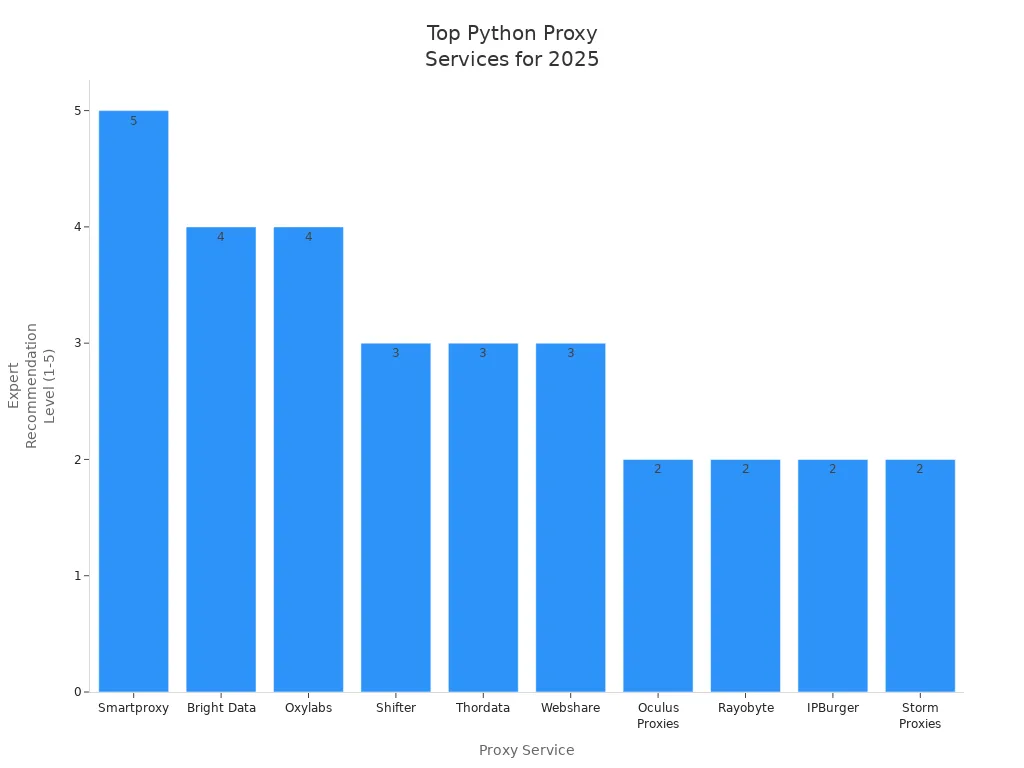
Experts rate these providers in the chart below:
Why Yilu Proxy is a Top Choice
Yilu Proxy is one of the best proxy providers for python requests rotating proxy. You get a big and mixed IP pool with many ways to rotate. Yilu Proxy lets you pick residential or datacenter proxies. This helps you choose what works best for scraping or automation. The dashboard and API are easy to use. Both new and skilled users can connect with Python requests.
You get good prices and a free trial to test the service. Yilu Proxy’s network is fast and reliable. This helps you avoid bans and keep your connection steady. Many people like Yilu Proxy because it is not too expensive and works well. If you need a proxy for scraping, automation, or handling many accounts, Yilu Proxy gives you the tools and support you need.
Why Use Rotating Proxies for Web Scraping
Overcoming IP Bans and Rate Limits
Web scraping projects can get blocked by websites. This happens when you send too many requests from one IP address. Websites use bans and rate limits to stop bots. Rotating proxies help by changing your IP address often. This makes you look like many users, not just one. Ip rotation keeps your requests safe from blocks.
Here is how different proxy types help you avoid bans:
Proxy Type | Key Advantages | How It Helps with Bans and Limits |
|---|---|---|
Datacenter Proxies | Fast, low cost | Good for speed, but easy to detect and block |
Residential Proxies | Real ISP IPs, high anonymity | Harder to block, mimic real users |
Rotating Proxies | Change IP per request or session | Prevents overuse of any single IP, avoids bans |
Mobile Proxies | Use mobile network IPs, very covert | Bypass advanced anti-bot systems, but more costly |
Rotating proxies spread your requests across many IPs. This keeps your scraping apis working well. Ip rotation lowers failed requests and helps you avoid anti-bot systems. You get better results and more success with web scraping.
Enhancing Anonymity and Access
Rotating proxies do more than stop bans. They help you stay anonymous online. Changing IP addresses often makes it hard for websites to track you. This privacy is important for web scraping. It helps when sites have strong anti-bot rules.
You can also reach geo-restricted content. Rotating proxies let you pick IPs from different countries. This helps you scrape data from sites that block some locations. You can target many regions and see all the data you need.
Rotating proxies hide your real IP address.
They help you get past IP blocks and stay hidden.
You can reach geo-restricted content with different IPs.
They make web scraping more reliable and easier to grow.
Frequent ip rotation lowers the risk of bans and keeps data collection smooth.
These benefits let you run big web scraping projects without problems. You get better data, more success, and can access information from anywhere.
Choosing the Best Web Scraping Proxies
Reliability and Speed
When you pick web scraping proxies for Python, focus on reliability and speed. Reliable proxies keep your connection steady. They help stop failed requests. Fast proxies make your scripts run better. They help you finish tasks quickly. If a proxy is slow, your requests can take longer. Sometimes, they might even time out. Unstable proxies can break your scraping. This lowers your success rate. You can check these things by timing your requests. Try testing with more than one thread. For example, use Python’s requests library to see how fast you get a response:
import requests
import time
proxies = {"http": "http://eu.gw.proxy.cc:1234"}
url = "http://example.com"
start_time = time.time()
try:
    response = requests.get(url, proxies=proxies, timeout=10)
    response.raise_for_status()
    end_time = time.time()
    print(f"The response time for proxies is: {end_time - start_time:.2f} seconds")
except requests.exceptions.RequestException as e:
    print(f"Request failed. Error reason: {e}")
Paid proxies are better than free ones. They give you more uptime and support. They also work faster. Dedicated proxies usually work better than shared ones.
IP Pool and Rotation Features
A big IP pool and good ip rotation are important for web scraping. If your provider has many IPs, you can spread your requests out. This helps you avoid bans and getting caught. Automatic ip rotation changes your IP often. This makes your traffic look real. Some providers let you keep the same IP for a while. This copies real browsing. These things help you beat anti-bot systems. Your scraping will work better and not stop.
Here is a quick table to compare proxy types:
Criteria | Residential Proxies | Datacenter Proxies | Mobile Proxies |
|---|---|---|---|
Scale | Medium to high | High | Medium |
Speed | Medium | High | Medium |
Security | High | Medium | High |
Budget | Moderate to expensive ($$) | Low cost ($) | Expensive ($$$) |
Pros | High anonymity, diverse IPs | Fast, cost-effective | Harder to detect, mobile-specific targets |
Cons | Expensive | Higher risk of IP blocks | Expensive |
Tip: Rotate proxies often and change headers to look real. Use user agents and pick the best proxy protocol for your job.
Pricing and Free Trials
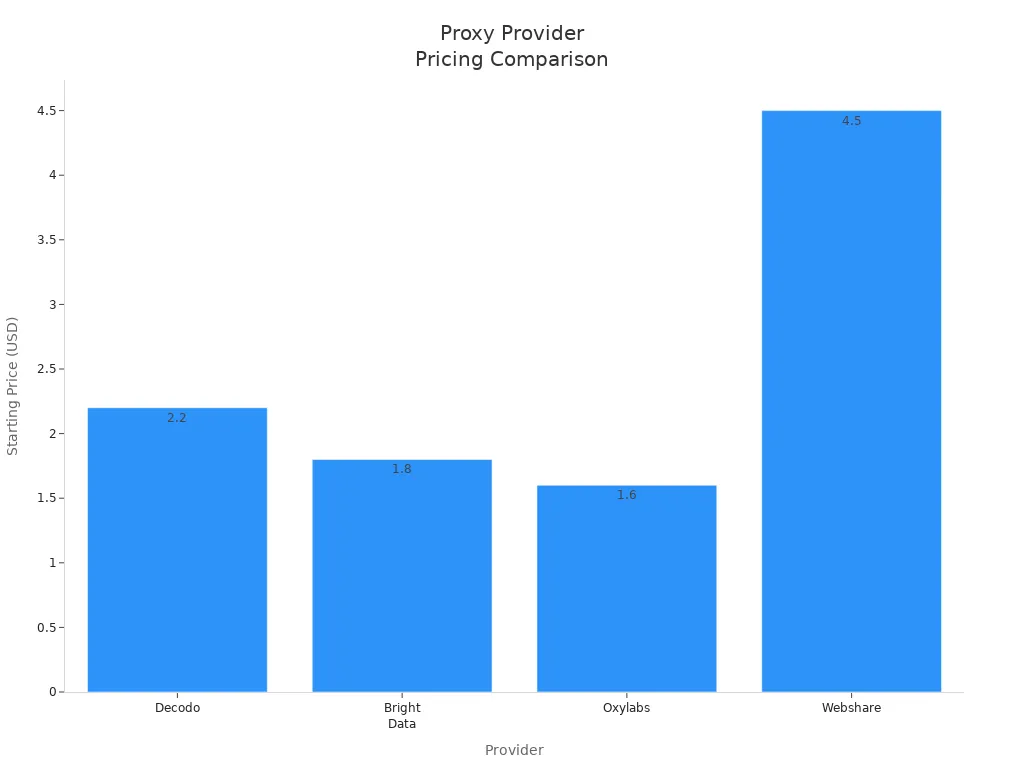
Pricing and free trials are important when picking proxies. Some providers have good prices and flexible plans. Free trials let you test before you buy. Decodo (Smartproxy) has a low price and a 3-day free trial. Bright Data and Oxylabs also have trials, but cost more. Webshare is cheaper but has no free trial for residential proxies.
Provider | Starting Price | Free Trial / Refund Policy | Key Features Relevant to Python Requests Users |
|---|---|---|---|
Decodo (formerly Smartproxy) | $2.2/GB (monthly), $7/GB pay-as-you-go | 3-day free trial, 14-day money-back guarantee | 55M+ residential IPs, 99.68% success rate, Python integration examples, advanced rotation, sticky sessions |
Bright Data | $1.8/IP (starting) | 7-day free trial for businesses, 3-day refund for individuals | 700K ISP proxies, customizable rotation, unlimited parallel requests, Python compatible |
Oxylabs | $1.6/IP (starting) | Free trial available upon contacting sales | ISP proxies in 20+ countries, 99.98% success rate, unlimited sessions, Python usage supported |
Webshare | $4.5/GB | No free trial for residential proxies | 30M+ residential IPs, 99.97% uptime, automatic proxy rotation, budget-friendly option |
Pick a provider that matches your needs. Residential proxies are best for privacy. Datacenter proxies are good for fast and cheap jobs. Mobile proxies help with mobile sites. Always check for rotation and trial offers before you choose.
Comparison Table of Top Providers

Feature Overview
Picking a proxy provider for Python requests can be tricky. You need to know what each one offers. The table below shows the main features side by side. You can look at proxy types, IP pool size, rotation settings, targeting, connections, coverage, prices, and trial offers. This makes it easier to choose the best proxy for web scraping or automation.
Provider | Proxy Types Offered | Number of IPs | Rotation Settings | Targeting Options | Concurrent Connections | Geographic Coverage | Pricing Highlights | Trial/Free Offer |
|---|---|---|---|---|---|---|---|---|
Yilu Proxy | Residential, Datacenter; SOCKS5, HTTP | 90M+ | Per request, sticky sessions | Country, city | Unlimited | 200+ countries | Not listed | Free trial for new users |
Smartproxy (Decodo) | Residential, Datacenter, Mobile, ISP; HTTP(S), SOCKS5 | 55M+ | Per request, sticky sessions | Country, city, ASN | Unlimited | 195+ countries | From $7/GB, pay-as-you-go | 14-day money-back guarantee |
SOAX | Residential, Mobile, ISP, Datacenter | 8.5M+ | Per request, sticky sessions | Country, city, ASN | Unlimited | 195+ countries | Residential $4/GB, ISP $3.5/GB | 3-day trial for $1.99 |
Webshare | Residential, Static (ISP), Datacenter; HTTP, SOCKS5 | 30M+ | Per request, sticky sessions | Country, city | Unlimited | 150+ countries | Residential from $3.5/month | Free plan: 10 proxies, 1GB/month, no card needed |
Oxylabs | Residential, Datacenter, ISP, Mobile | 100M+ | Per request, sticky sessions | Country, city, ASN, ZIP | Unlimited | 195+ countries | Residential $4/GB, Datacenter $0.65/GB | 7-day free trial (business), 3-day refund (individual) |
NetNut | Static & Rotating Residential; SOCKS5, HTTP | 52M+ | Per request, sticky sessions | Country, city | Unlimited | 150+ countries | Not specified | No explicit trial info |
Always check if the proxy provider has the protocols and rotation modes you want. Some providers let you target more specific places. This helps you get the data you need.
Each proxy provider has something special. Yilu Proxy has a huge IP pool and a free trial for new users. Smartproxy (Decodo) and SOAX have flexible prices and cover many countries. Webshare is cheap and has a free plan. Oxylabs has the biggest IP pool and advanced targeting. NetNut is good for dedicated IPs and scraping APIs.
The best proxy for you depends on your project size, budget, and what you need. If you want to try before you pay, look for free trials or money-back offers. Make sure the proxy type and rotation match your Python requests setup for the best results.
Reviews of Best Web Scraping Proxies
Yilu Proxy – Free Trial and Versatility
Yilu Proxy is a flexible choice for web scraping proxies. You can use SOCKS5 proxies for fast and steady connections. These proxies send your traffic straight to the server. This gives you better speed and more stable performance. Yilu Proxy works for many things like HTTP requests, FTP, P2P sharing, gaming, streaming, and VoIP. This makes it good for work and personal use.
Setting up Yilu Proxy is easy. You just type in the server address and port. Then you can start using it. The free trial lets you try the service before you pay. Many people say Yilu Proxy helps a lot, especially in e-commerce. It makes their work better. The service has strong authentication. You can use a username and password or add two-factor authentication. This keeps your data safe.
Yilu Proxy’s SOCKS5 proxies help you stay hidden by masking your real IP address. You can get past geo-blocks and firewalls. This lets you reach content that is blocked. These proxies do not encrypt your data. But they are faster than VPNs. If you want both privacy and speed, Yilu Proxy is a good pick. You also get clear prices and helpful customer support during your trial.
Tip: Pick a trusted proxy provider with good support. This will help you have a smooth free trial.
Smartproxy (Decodo) – Best Value Residential
Smartproxy, now called Decodo, has one of the biggest residential proxy pools. You get 115 million residential IPs in over 195 countries. This helps you target almost any place for web scraping. Decodo’s proxies work well, with about 99.95% success and quick response times from 0.44 to 0.82 seconds.
You can change proxies with every request or keep sticky sessions for up to 24 hours. This helps you act like a real user and avoid getting caught. Decodo supports HTTP, HTTPS, and SOCKS5 protocols. You can use it with many tools and scripts. You can run lots of Python requests at the same time. This is great for big web scraping projects.
Here is a quick overview:
Metric | Details |
|---|---|
Proxy Pool Size | 115 million residential IPs in 195+ countries |
Success Rate | About 99.95% average success rate |
Average Response Time | 0.44s (EU) to 0.82s (Brazil) |
Protocols Supported | HTTP, HTTPS, SOCKS5 (UDP available) |
Concurrency | Unlimited |
Pricing | Starts at $3.5 per GB, PAYG and subscription plans |
Filtering Options | Country, state, city, ASN, ZIP code (US only) |
You can pick pay-as-you-go or monthly plans. Decodo is a good deal for small and big projects. It works easily with Python requests and has strong scraping APIs. Developers like it a lot.
SOAX – Best Mobile and Web Scraping Performance
SOAX is a top choice for mobile and web scraping. You get a huge proxy network with over 191 million IPs. These include residential, mobile, ISP, and datacenter proxies. SOAX uses AI to rotate IPs. This helps you beat anti-bot systems and keeps your sessions steady. You can change IPs for each request or keep sticky sessions for logins.
SOAX’s mobile proxies are great for scraping sites that block regular residential IPs. The platform lets you run thousands of threads at once and gives you real-time analytics. You can pick proxies by country, city, or ASN. This helps you get local data.
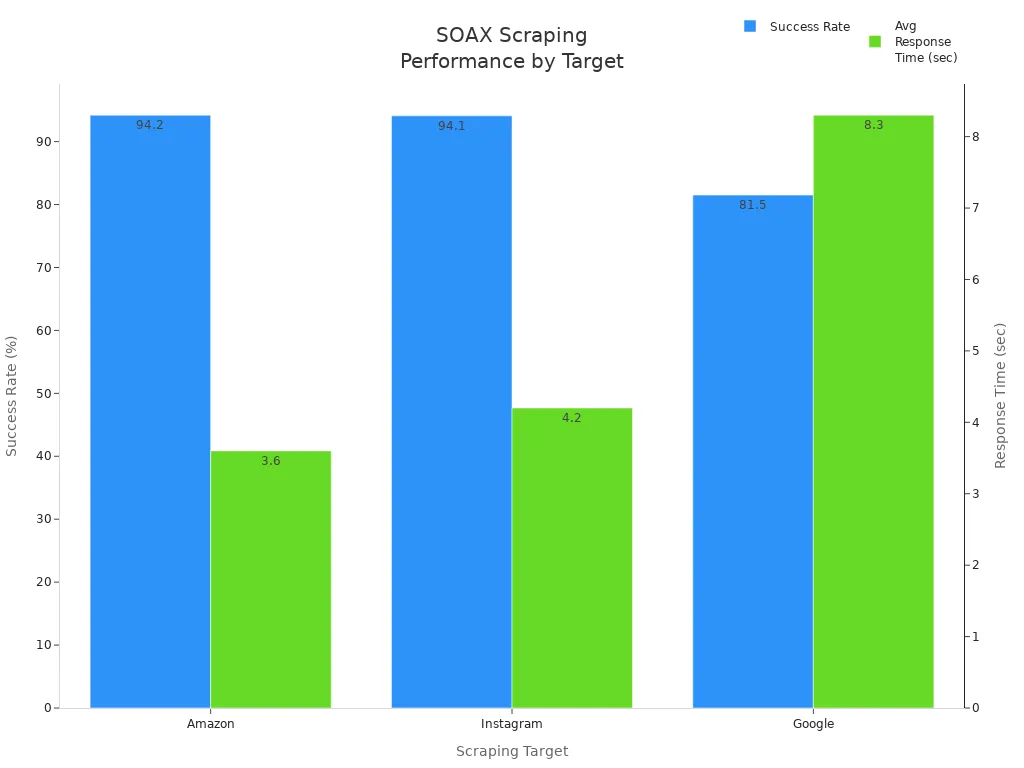
Tests show SOAX gets over 90% success on big sites. Amazon and Instagram have more than 94% success. Google is harder, with about 81.5% success. Response times are between 3.6 and 8.3 seconds, depending on the site.
SOAX has scraper APIs that handle navigation and data extraction. You do not need to manage proxy servers yourself. The service follows GDPR and CCPA rules. This keeps your web scraping legal and safe.
Webshare – Cheapest Datacenter and ISP Proxies
Webshare offers some of the cheapest datacenter proxies. They are reliable and cost very little. You can start with datacenter proxies at just $0.018 each. These proxies are fast, up to 950 Mbps, and have unlimited bandwidth. You get 99.97% uptime and dedicated IPs. They are good for basic web scraping, testing, and automation.
If you want more stability, Webshare’s ISP proxies give you static residential IPs from big ISPs like AT&T and Verizon. These cost more, starting at $0.23 each. But they are very reliable and have broadband speeds. ISP proxies are best for long-term jobs like account management and SEO monitoring.
Proxy Type | Cost per Proxy | Speed & Performance | Reliability & Uptime | Best Use Cases |
|---|---|---|---|---|
Datacenter Proxies | Starting at $0.018 | Up to 950 Mbps, unlimited bandwidth | 99.97% uptime, dedicated IPs | Basic web scraping, testing, automation |
ISP (Static Residential) Proxies | Starting at $0.23 | Broadband-like speeds, static IPs | High reliability due to ISP origin | Long-term tasks like account management, SEO monitoring |
You can change your plan for static residential proxies to fit your needs. Webshare’s strong infrastructure and 24/7 support make sure you get good service for web scraping proxies.
Oxylabs – Wide Residential Proxy Options
Oxylabs has a big pool of real residential IP addresses. This helps you avoid blocks and limits when scraping websites. You can get past geo-restrictions and reach data from almost any country. The proxies work well with Python requests and are easy to set up.
You get advanced features like proxy rotation, authentication, and secure connections. Oxylabs is good for large scraping jobs. You can collect lots of data without worrying about bans. Free trials let you test the service before you buy more. The company follows strict rules, so your scraping stays legal.
Note: Oxylabs’ residential proxies give you high privacy, reliability, and scalability for web scraping.
NetNut – High-Volume Datacenter Proxies
NetNut is best for high-volume scraping with its big datacenter proxy pool. Most IPs are in the US and India. You get about 150,000 datacenter IPs. This is great for projects that need lots of datacenter proxies for collecting data. Tests show a 96.54% success rate for US requests and an average response time of 0.22 seconds.
NetNut’s proxies work well for Google scraping, with a 96.67% success rate. But they do not do as well on sites like Amazon, where the success rate drops to 22.93%. Download speeds are slower than some other providers, with a median of 0.84 MB/s. Prices start at $100 for 100 GB. This is expensive for small users but better for big projects.
If you need a proxy provider for lots of scraping and can work with the location limits, NetNut is a good choice. You get decent performance and a big IP pool. But you might have speed and reliability problems on some sites.
Other Notable Providers
There are other web scraping proxies you might like:
Bright Data: Has a huge IP pool and smart proxy tools. You get high success rates and flexible prices.
Zyte: Offers smart proxy management, retry logic, and easy APIs. You can use it for both residential and datacenter proxies.
Shifter: Has a large network with many rotation methods and strong uptime. Good for privacy and scraping.
IPBurger: Focuses on US proxies. Helps you get past bans and captchas for US scraping.
Storm Proxies: Gives you fast, cheap proxies with three rotation modes. Good for quick jobs and saving money.
When picking a web scraping proxy, look for things like ethical sourcing, smart IP rotation, anti-detection tools, and privacy law compliance. The best datacenter proxies and residential proxies help you get high success rates and reliable data.
How to Use Python Requests Rotating Proxy
Integration Steps
When you use a python requests rotating proxy, you can avoid bans. This helps you collect data without problems. Here are some easy steps to follow:
Make a list of proxy addresses. Put your proxies in a list. Add usernames and passwords if your provider asks for them.
Create a function to choose a proxy. Pick a random proxy each time. This way, every request uses a new IP.
Build the proxies dictionary. Change the dictionary for each request. Use the proxy you picked.
Send your HTTP request. Use the requests library. Give it the proxies dictionary.
Sign up for a rotating proxy service. Pick a provider like Yilu Proxy. They give you automatic IP rotation.
Set up authentication. Add your username and password if you need them.
Watch for errors and manage sessions. Catch any problems. Slow down your requests so you do not get banned.
Tip: Test your proxies before you start big scraping jobs. This helps you find slow or blocked IPs early.
Example Code with Yilu Proxy
You can use Yilu Proxy with python requests rotating proxy by following this example. The code below shows how to change proxies for every request:
import requests
import random

# List of Yilu Proxy endpoints (replace with your actual proxy list)
proxies_list = [
    "http://username:password@proxy1.yilu.us:12345",
    "http://username:password@proxy2.yilu.us:12345",
    "http://username:password@proxy3.yilu.us:12345"
]

def get_random_proxy():
    return random.choice(proxies_list)

url = "https://httpbin.org/ip"

for i in range(5):
    proxy = get_random_proxy()
    proxies = {"http": proxy, "https": proxy}
    try:
        response = requests.get(url, proxies=proxies, timeout=10)
        print(f"Request {i+1}: {response.json()}")
    except requests.exceptions.RequestException as e:
        print(f"Request {i+1} failed: {e}")
This script changes your proxy for every request. You can use this method for bigger scraping projects. Yilu Proxy works with HTTP and SOCKS5. You can pick the protocol you want.
Tips for Safe and Effective Proxy Use
Avoiding Common Pitfalls
If you use proxies for web scraping, you need to be careful. Some mistakes can get you banned or put you at risk. Here are some easy steps to help you stay safe and work well:
Pick trusted proxy services. Good providers let you spread requests over many IPs. This makes it harder for websites to catch you.
Change proxies often. Switching IPs helps hide your actions and stops overuse.
Follow rate limits. Wait between requests and do not send too many at once.
Act like a real person online. Mix up your actions, change headers, and browse like normal.
Handle CAPTCHAs carefully. Use good solving services or check them yourself to avoid getting caught.
Test your proxy setup a lot. Make sure everything works the way you want.
Do not use open proxies. These are risky and can cause security problems. Residential proxies are safer and help you avoid bans.
Use IP rotation algorithms. Watch how healthy and trusted your IPs are.
Only collect the data you need. Be honest and follow rules to build trust.
Tip: Check your scraping often. This helps you find problems early and keeps things running well.
Best Practices for Web Scraping
You can get better results from web scraping if you follow these tips. They help you stay fair and out of trouble:
Follow website rules. Look at the terms of service and robots.txt before you scrape.
Slow down your requests. Give servers time so you do not overload them.
Use rotating residential proxies. These act like real users and help you stay hidden.
Only take public data. Give credit if you use someone else’s info.
Watch how your scraping affects websites. Change what you do if you see issues.
Rotate proxies to get past anti-bot systems and reach blocked content.
Collect less data. Keep your proxy passwords safe and use encryption.
Follow laws like the Computer Fraud and Abuse Act. Learn about legal rules.
Set clear goals for your data. Add retry steps to your scrapers for better results.
Use sticky IPs when you need to keep a session, like logging in or paging through data.
Write down where you get your data and how you collect it. This shows you are honest.
A smart anti-detection engine can help you rotate proxies and act like a real user. This keeps your web scraping safe and working well.
You have lots of good choices for Python requests rotating proxy in 2025. Every proxy provider has its own strong points and some weak spots:
Proxy Service | Strengths | Weaknesses |
|---|---|---|
Bright Data | Big network, smart tools, works fast | Hard pricing, expensive for one person |
Webshare | Easy to change, simple to use, saves money | Not always open for help, prices change |
Oxylabs | Very big network, steady, made for big companies | Costs more, not much self-service |
Decodo (Smartproxy) | Simple, many plans, quick speed | Only US datacenter, more cost for more IPs |
Rayobyte | Cheap, many choices, good help | Few ISP places, some limits |
IPRoyal | Low price, lots of IPs, basic tools | No rotation, not much targeting |
Picking the best proxy provider helps you get faster and more reliable results. You can do bigger projects if you match the proxy type to your needs and check how well it works. Yilu Proxy is special because it gives a free trial and works easily with Python. Try Yilu Proxy’s free trial to see how rotating proxies help your project.
FAQ
What is a rotating proxy and why do you need it for Python requests?
A rotating proxy changes your IP address with each request. You avoid bans and blocks when scraping websites. You look like many users instead of one. This keeps your data collection smooth and reliable.
How do you set up a rotating proxy with Python requests?
You add a list of proxy addresses in your script. You pick a new proxy for each request. Use the proxies parameter in the requests.get() function. This helps you rotate IPs easily.
Can you use free proxies for web scraping?
You can use free proxies, but they often fail. Free proxies have slow speeds and low reliability. Paid proxies give you better uptime, support, and security. You get more success with paid options.
What should you look for in a proxy provider for Python scraping?
You should check these features:
Large and diverse IP pool
Fast speeds
Easy rotation options
Good customer support
Free trial or refund policy
Tip: Always test the proxy with your script before starting big projects.