
 By Yilu Support

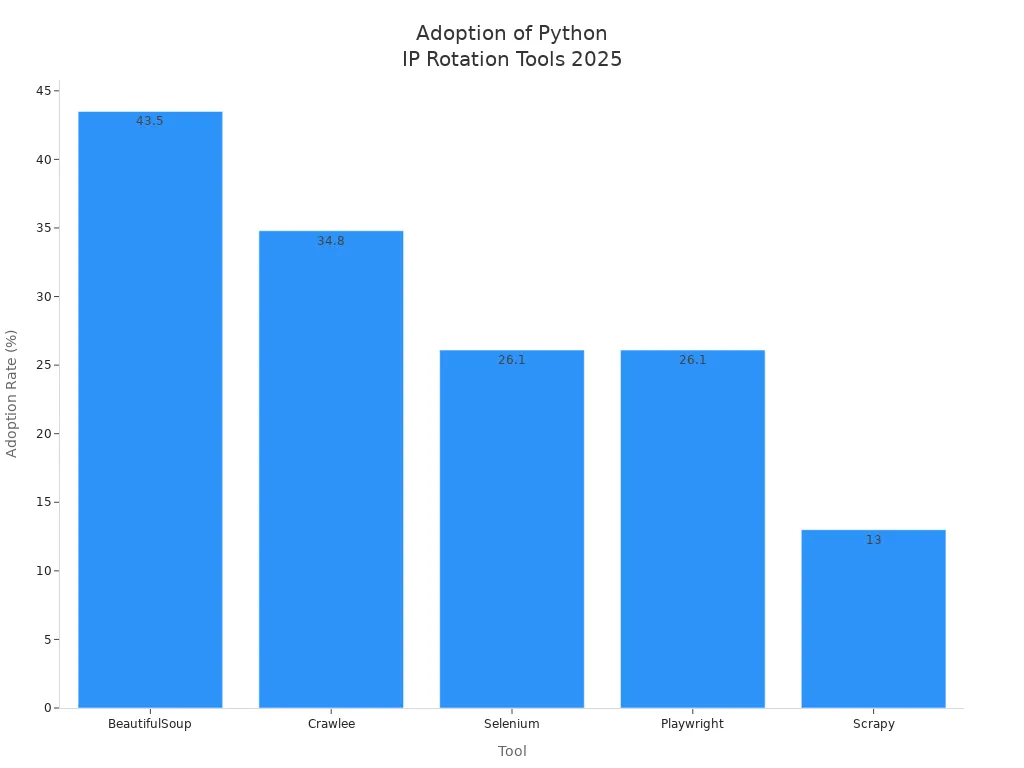
You want your scraper to be smart. It should not work too hard. Open-source web scrapers help with this. They let you change IPs and avoid blocks. Here are the most popular open-source tools for ip rotation python in 2025. Many developers use web scrapers like BeautifulSoup, Crawlee, and Scrapy. These tools help keep your data safe. They also make your data collection reliable.
Tool | Adoption Rate (%) | Python Compatible | Notes on IP Rotation Relevance |
|---|---|---|---|
BeautifulSoup | 43.5 | Yes | Used a lot for scraping; needs proxies for IP rotation |
Crawlee | 34.8 | Yes | New Python support; proxy/IP rotation will be added soon |
Selenium | 26.1 | Yes | Can automate browsers; often used with proxies |
Playwright | 26.1 | Yes | Automates browsers and works with proxies |
Scrapy | 13 | Yes | Well-known scraping tool; proxy/IP rotation is important |
If you want safe and easy IP management, try Yilu Proxy’s free trial. Open-source tools help you save money. They also keep your scraper working well.
Key Takeaways
Rotating IPs helps your scraper not get blocked. It makes requests look like they come from many people.
Open-source Python tools like Scrapy, Crawlee, and Selenium Wire help with IP rotation. They make scraping work better and give you more options.
Yilu Proxy’s free trial lets you use good rotating proxies. These proxies help your scraper stay private and work faster.
You should add delays, change user agents, and follow website rules. These steps keep your scraper safe and working well.
Pick tools that match what you need. Some tools are easy to set up, have good support, or have special features for big projects.
Why IP Rotation Matters
Web Scraping
You want your scraper to get data without blocks. If you use the same IP, websites notice you. They see many requests from one address. This can cause bans or CAPTCHAs. Sometimes, whole IP ranges get blocked. Sending lots of requests from one IP is risky. Anti-bot systems will catch you. That’s why ip rotation python helps a lot. Changing IPs makes your scraper look like many users. Open-source web scrapers help with this. They let you use rotating proxies. You can get data from many sites easily.
Tip: Rotating proxies lower your chance of getting blocked. Your web scraping works better and smoother.
Automation
Automation saves you time and work. You can set your scraper to run every day. It can even run every hour. But using one IP can get you blocked fast. Rotating proxies help hide your scraper. With ip rotation python, you change IPs for each request. This makes your scraper less suspicious. Open-source web scrapers have tools for easy IP rotation. You get better results and fewer problems.
Rotating proxies keep your automation safe.
You avoid bans and your scraper works longer.
Open-source web scrapers give you flexible IP rotation options.
Privacy
Privacy is important for web scraping. You don’t want websites to track your scraper. You don’t want them to link your requests. Rotating proxies protect your identity. They make it hard for websites to follow you. Using ip rotation python means you switch IPs often. This keeps your scraper hidden. It helps you get past geo-restrictions. Open-source web scrapers with rotating proxies give you better privacy. You get higher success rates. You can scrape data without worrying about being watched or blocked.
Note: Rotating proxies and open-source web scrapers give you more privacy and freedom when scraping.
Criteria for Open-Source Tools
When you look for the best open-source options for IP rotation, you want to make sure they fit your needs. Let’s break down what matters most.
Python Compatibility
You want your open-source solution to work smoothly with python. This makes your setup easier and helps you avoid extra steps. Most popular open-source projects support python, so you can use them right away. Look for features like easy integration, flexible extraction rules, and support for proxies. Some tools even let you export data in different formats. If you are just starting, a user-friendly interface can help you get going fast.
Tip: Choose open-source projects that offer built-in extraction rules and flexible methods for selecting web page elements. This saves you time and effort.
Community Support
A strong community can make your experience much better. When you use open-source python projects, you want to see active users, lots of stars on GitHub, and helpful guides. Projects with more stars and forks often have more updates and better support. For example, some IP rotation projects have only a few stars, while others have hundreds or even thousands. You can see the difference in the chart below:
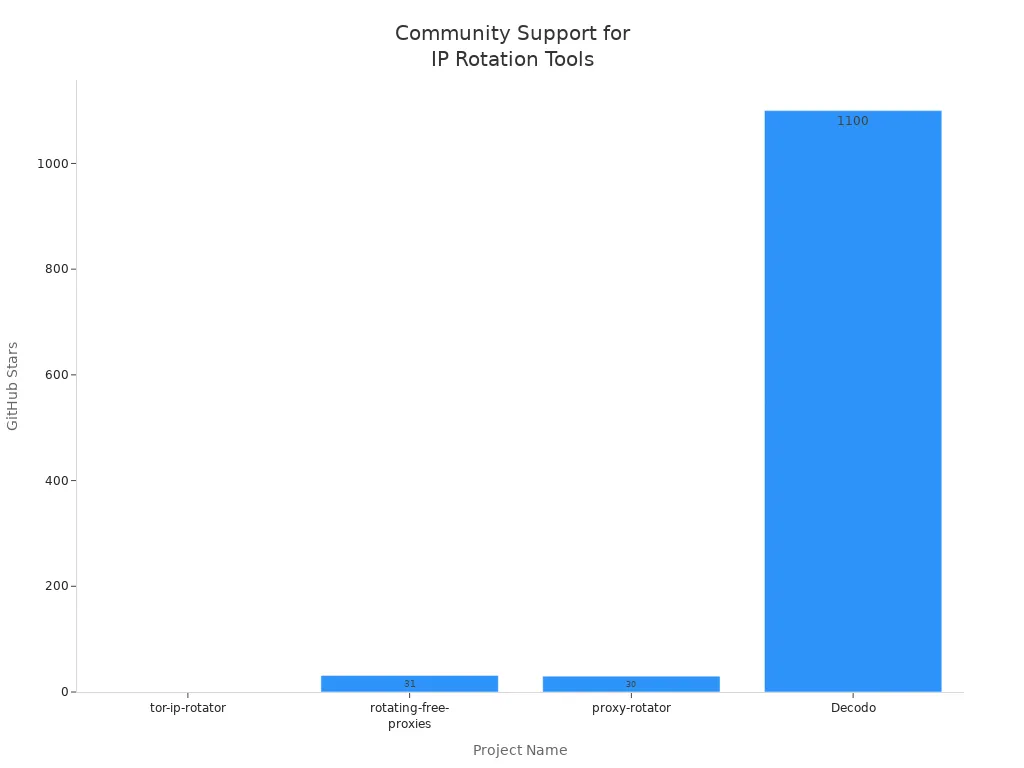
If you run into trouble, a big community means you will find answers faster. You also get more plugins and add-ons from other users.
Scalability
You want your open-source python solution to grow with your needs. If you plan to scrape a lot of data, you need a tool that can handle it. Here are some ways open-source projects help you scale:
Use rotating proxies to change IPs and avoid bans.
Pick premium proxies for better speed and reliability.
Run multiple scrapers at once with asynchronous or multiprocessing methods.
Add delays between requests to stay under the radar.
Store large amounts of data with advanced systems like MongoDB.
A good open-source project lets you manage many requests, handle errors, and keep your scraper running smoothly. You can even use cloud services or multiple servers for bigger jobs.
Top Open-Source Tools for IP Rotation Python

Scrapy
Scrapy is a very popular open-source web scraper for Python. You can use it to build scrapers for big projects. Scrapy lets you change IPs by using rotating proxies and proxy services. This helps your scraper avoid bans and CAPTCHAs.
Key Features:
You can change IPs for each request. This makes your scraper look like many users.
RetryMiddleware helps try again if a request fails. This is useful if you get banned.
AutoThrottle slows down your scraper so you don’t overload websites.
You can add delays between requests to keep things steady.
User agent rotation makes your scraper seem more real.
You get logs and monitoring to see bans and fix problems.
Pros:
It is flexible and strong for big scraping jobs.
There is a big open-source community and many plugins.
It works well with Python and many proxy services.
Cons:
You need outside proxies for real IP rotation.
Setup can be hard for beginners.
There is no one-click IP rotation feature.
Integration with Yilu Proxy:
You can use Yilu Proxy’s free trial with Scrapy. Just set the proxy address in Scrapy settings. This gives your scraper a pool of rotating proxies. It makes it harder for websites to block you.
Example Use Case:
You want to scrape prices from many e-commerce sites. Scrapy and Yilu Proxy help you rotate IPs and avoid blocks.
ZenRows
ZenRows makes web scraping easier by combining proxy rotation, CAPTCHA solving, and JavaScript rendering. ZenRows does most of the hard work for you. You do not need to set up rotating proxies or worry about anti-bot systems.
ZenRows gives you an API that rotates proxies, solves CAPTCHAs, and runs headless browsers. You get raw HTML or structured data. ZenRows handles anti-bot steps in the background. The platform has over 55 million residential proxies in more than 190 countries. This is great if you want to scrape protected sites without much setup.
Pros:
It automates proxy rotation and anti-bot steps.
It works with sites that use a lot of JavaScript.
It is easy to use, even for beginners.
Cons:
It is not fully open-source; you use their API.
You need some tech skills for advanced features.
Integration with Yilu Proxy:
You can use Yilu Proxy’s free trial as your proxy provider with ZenRows. Just set the proxy endpoint in your API requests. This gives your scraper even more IP rotation.
Example Use Case:
You need to scrape data from a site protected by Cloudflare. ZenRows and Yilu Proxy help you get past blocks and get the data.
Tor with Python
Tor gives you strong privacy and lets your scraper change IPs by sending traffic through its network. You can use Tor with Python to make your scraper anonymous and get around geo-restrictions.
Aspect | Pros | Cons |
|---|---|---|
Anonymity | Increases privacy by changing IPs and User-Agent headers. | N/A |
Geo-Restrictions | Lets you reach content from different countries. | N/A |
IP Ban Avoidance | Helps you avoid bans when scraping. | N/A |
Penetration Testing | Good for hiding your IP during security tests. | N/A |
Speed | N/A | Tor can be slow, which may slow down your scraper. |
Exit Node Reliability | N/A | Some exit nodes get blocked, causing connection issues. |
Legal Considerations | N/A | You must follow the law when using Tor. |
Ethical Use | N/A | Too many requests can harm the Tor network; use it responsibly. |
Integration with Yilu Proxy:
You can use Yilu Proxy instead of Tor for faster speeds and more reliable rotating proxies. Just set Yilu Proxy as your proxy in your Python scripts.
Example Use Case:
You want to scrape news sites from different countries. Tor helps you rotate IPs and stay hidden, but Yilu Proxy gives you better speed and reliability.
Scrapoxy
Scrapoxy is an open-source tool that acts as a smart proxy manager for your scraper. It lets you use cloud servers as rotating proxies. You can scale up or down when you need to. Scrapoxy works well with Python and helps your scraper avoid bans by switching IPs often.
Key Features:
Manages a group of cloud-based proxies.
Supports auto-scaling, so you only use what you need.
Works with AWS, Azure, and other cloud services.
Lets you watch and control your proxy use.
Pros:
Open-source and free to use.
Scalable for big scraping projects.
Works with many cloud platforms.
Cons:
Needs some setup and cloud knowledge.
You must manage your own cloud accounts.
Integration with Yilu Proxy:
You can add Yilu Proxy as a backend to Scrapoxy. This gives your scraper a big pool of rotating proxies without managing cloud servers yourself.
Example Use Case:
You want to scrape millions of pages for a research project. Scrapoxy and Yilu Proxy give you the rotating proxies you need to avoid bans.
ProxyBroker
ProxyBroker is a Python library that helps you find and use free proxies for your scraper. It searches the internet for working proxies and tests them for speed and privacy. ProxyBroker is open-source and easy to use with Python.
Key Features:
Finds thousands of free proxies.
Tests proxies for speed and reliability.
Supports HTTP, HTTPS, and SOCKS proxies.
Lets you filter proxies by country or type.
Pros:
Open-source and simple to set up.
Good for small projects or learning.
No cost for basic use.
Cons:
Free proxies can be slow or unreliable.
Not ideal for large-scale scraping.
Integration with Yilu Proxy:
You can use Yilu Proxy as a premium proxy source with ProxyBroker. This gives your scraper more reliable rotating proxies and better performance.
Example Use Case:
You want to build a simple web scraper for a school project. ProxyBroker helps you find free proxies, and Yilu Proxy gives you more stable options.
PyProxy
PyProxy is a flexible open-source tool for managing proxies in Python. It works for both small and big scraping projects. PyProxy can handle thousands of proxies without slowing down your scraper. You can use it to rotate IPs and avoid bans.
PyProxy works well for most users, from small businesses to big companies. You can run many scrapers at once and manage a large group of rotating proxies. If your project gets very big, you might see some limits.
Pros:
Open-source and works well with Python.
Handles lots of proxies at once.
Good for both small and big scraping jobs.
Cons:
May hit resource limits in huge projects.
Needs some setup for best results.
Integration with Yilu Proxy:
You can set Yilu Proxy as your proxy provider in PyProxy. This gives your scraper a reliable pool of rotating proxies, making your scraping smoother.
Example Use Case:
You want to scrape thousands of product listings every day. PyProxy and Yilu Proxy keep your scraper running fast and avoid bans.
Crawlee
Crawlee is a newer open-source tool that supports Python and makes proxy management simple. You can add proxy URLs to your crawler with just a few lines of code. Crawlee supports different proxy levels, so you can start with cheaper options and move up if you get blocked.
Key Features:
Easy proxy setup in Python.
Supports many proxy types, from datacenter to residential.
Rotates proxies in a round-robin way for smooth scraping.
Works with different crawlers like PlaywrightCrawler and BeautifulSoupCrawler.
Crawlee’s SessionPool manages IP rotation by removing bad proxies and stopping your scraper from retrying blocked IPs. It links cookies and tokens to certain IPs, which helps avoid detection.
Pros:
Open-source and flexible.
Simple to use with Python.
Reduces the risk of bans with smart IP rotation.
Cons:
Still growing in features for Python.
Needs some setup for advanced use.
Integration with Yilu Proxy:
You can add Yilu Proxy’s rotating proxies to Crawlee’s proxy list. This gives your scraper more IPs and better ban protection.
Example Use Case:
You want to scrape job postings from many sites. Crawlee and Yilu Proxy rotate IPs and keep your scraper working smoothly.
Requests with Rotating Proxies
The Requests library is a favorite for many Python users. You can use it with rotating proxies to build a simple but strong scraper. By changing the proxy for each request, you keep your scraper hidden and avoid bans.
Feature/Benefit | Explanation |
|---|---|
IP Rotation | Changes IPs per request or at set times, stopping detection and bans. |
Avoiding IP Bans | Keeps websites from blocking your scraper by switching IPs often. |
Enhanced Security | Hides your real IP, making your scraper safer. |
High Anonymity | Each request looks like it comes from a different user. |
Proxy Pool Diversity | Uses many fresh IPs from different places, lowering block risk. |
Residential vs Data Center IPs | Residential IPs look more real and are harder to block. |
Sticky Sessions | Keeps the same IP for multi-step tasks when needed. |
Scalability | Handles lots of requests without triggering anti-bot systems. |
Integration with Yilu Proxy:
You can set Yilu Proxy as your proxy in your Python Requests code. This gives your scraper a big pool of rotating proxies, making your scraping safer and more reliable.
Example Use Case:
You want to watch prices on travel sites. Requests with Yilu Proxy helps your scraper rotate IPs and avoid getting blocked.
Selenium Wire
Selenium Wire is an open-source extension for Selenium. It lets you check and change requests made by your scraper. You can set up rotating proxies and change headers to make your scraper look more like a real user.
Key Features:
Lets you set proxies for each browser session.
Supports HTTP, HTTPS, and SOCKS proxies.
Captures and checks all network traffic.
Works with headless browsers for secret scraping.
Pros:
Open-source and works with Python.
Great for scraping sites with lots of JavaScript.
Gives you full control over requests.
Cons:
Uses more resources than simple scrapers.
Needs some setup for proxy rotation.
Integration with Yilu Proxy:
You can set Yilu Proxy as your proxy in Selenium Wire. This gives your scraper rotating proxies and helps you avoid bans on tough sites.
Example Use Case:
You want to scrape data from a site that uses lots of JavaScript. Selenium Wire and Yilu Proxy let your scraper rotate IPs and get the data you need.
Octoparse
Octoparse is a user-friendly open-source web scraper with a point-and-click interface. You do not need to code to set up scraping tasks. Octoparse handles dynamic content, login forms, and even CAPTCHAs. It supports IP rotation and proxy management to help your scraper avoid bans.
Lets you scrape complex sites with AJAX or dynamic content.
Supports scheduled and automated scraping.
Handles CAPTCHAs and rotating proxies with one click.
Offers built-in proxy pools and lets you add your own proxies.
Exports data in many formats and connects to Python workflows.
You can set up Octoparse to use rotating proxies from Yilu Proxy. This gives your scraper more IPs and better protection from bans.
Example Use Case:
You want to scrape real estate listings from a site with login forms and CAPTCHAs. Octoparse and Yilu Proxy rotate IPs and get the data without coding.
Tip: Try Yilu Proxy’s free trial to boost your scraper’s IP rotation power with any of these open-source tools. Sign up at https://aggproxy.org/trial-offer-2/.
Rotating Proxies Comparison
Features Table
It is important to choose the right tool for scraping. Every tool is good at some things and not so good at others. The table below helps you see how the top open-source Python tools for ip proxies and rotation compare:
Tool | Ease of Use | JavaScript Support | Proxy/IP Rotation | Strengths | Weaknesses | Best Use Case |
|---|---|---|---|---|---|---|
Crawlee | Moderate/Hard | Yes | Built-in | Handles static & dynamic pages, anti-block | Steep learning curve | Complex scraping with IP rotation |
ZenRows | Very Easy (API) | Yes | Built-in (API) | Simple, handles JS, scalable | Paid API, less control | Scraping protected sites at scale |
Scrapy | Moderate/Hard | Partial | Add-ons needed | Fast, extensible, async scraping | Needs setup for proxies | Large-scale structured crawling |
Selenium | Moderate | Yes | Manual setup | Browser automation, JS support | Slower, more code | Interactive, dynamic sites |
Playwright | Moderate | Yes | Manual setup | Modern web apps, multi-browser | No built-in anti-bot | JS-heavy sites |
Requests | Very Easy | No | Manual setup | Simple HTTP requests | No JS, no anti-bot | Static pages, APIs |
ProxyBroker | Easy | No | Built-in | Finds free proxies, easy to use | Free proxies unreliable | Small projects, learning |
PyProxy | Easy | No | Built-in | Handles many proxies, scalable | Needs setup for big jobs | Daily scraping, product listings |
Selenium Wire | Moderate | Yes | Manual setup | Full network control, JS support | Resource heavy | JS-heavy, anti-bot sites |
Octoparse | Very Easy | Yes | Built-in | No coding, handles CAPTCHAs | Less flexible for coders | Non-coders, dynamic content |
Tip: For hard-to-scrape sites, pick tools with built-in proxy rotation and anti-blocking. These features help you get past blocks.
Best Rotating Proxies for 2025
You want your scraper to run well and not get blocked. Crawlee is a great choice for both static and dynamic pages. It has built-in proxy rotation and tricks to avoid blocks. ZenRows is even easier to use because of its API, but you do not get as much control. Scrapy is good for big scraping jobs, but you must set up proxies yourself.
Yilu Proxy gives you a strong group of rotating proxies. Crawlee, Scrapy, and PyProxy work really well with Yilu Proxy. You can scrape e-commerce, job boards, or travel sites without worrying about bans. For smaller tasks, Requests or ProxyBroker with Yilu Proxy are good choices. If you do not want to code, Octoparse lets you add Yilu Proxy in just a few steps.
You can try other proxy providers, but Yilu Proxy’s free trial is a safe way to see what works best for your needs.
Getting Started with Yilu Proxy

Signup Steps
Ready to try Yilu Proxy? You can get started in just a few minutes. Here’s how you do it:
Go to the Yilu Proxy Free Trial page.
Click the Sign Up or Get Free Trial button.
Enter your email address and create a password.
Check your email for a confirmation link. Click it to activate your account.
Log in to your new account.
Find your dashboard. You will see your free trial credits and proxy details.
💡 Tip: If you do not get the confirmation email, check your spam or junk folder.
Integration Steps
You can use Yilu Proxy with any of the Python tools listed above. Here’s a simple way to add Yilu Proxy to your code:
For most Python tools (like Requests, Scrapy, or Selenium):
proxies = {
    "http": "http://username:password@proxy.yilu.us:12345",
    "https": "http://username:password@proxy.yilu.us:12345"
}
Replace username, password, and the proxy address with your Yilu Proxy details from your dashboard.
In Scrapy:
Add this to yoursettings.py:HTTP_PROXY = 'http://username:password@proxy.yilu.us:12345'In Selenium Wire:
Set the proxy in your driver options.
🛠️ Note: Each tool has its own way to set proxies. Check the docs for your tool if you get stuck.
Troubleshooting
Sometimes things do not work right away. Here are some quick fixes:
Proxy not working?
Double-check your username, password, and proxy address.Connection timeout?
Try a different proxy port or server from your dashboard.Blocked or banned?
Rotate your IP more often or slow down your requests.Still stuck?
Visit Yilu Proxy’s support page or ask in their help chat.
🚦 Remember: Most problems come from small mistakes in your proxy settings. Take your time and check each step.
Best Practices for IP Rotation Python
Avoiding Bans
You want your scraper to stay under the radar. Here are some smart moves to help you avoid bans:
Rotate proxies often. This spreads your requests across many IPs and keeps you from getting flagged.
Add realistic delays between requests. Fast, repeated requests look suspicious. Slow down and act like a real person.
Change user agents and headers. Websites spot bots by looking for patterns. Mix things up to look like different browsers.
Respect robots.txt and website rules. Scraping within limits keeps you safe and ethical.
Handle CAPTCHAs with care. Use tools to solve them or pause when you see one.
Watch for failed requests. If you get blocked, switch proxies right away.
Pick paid proxies for better speed and reliability. Free ones can be slow or risky.
Don’t overload servers. Spread out your requests, especially on small sites.
🛡️ Tip: Combine technical tricks with ethical scraping. This keeps your project running smoothly and legally.
Privacy Tips
Protecting your privacy matters when you scrape. Try these tips:
Use random delays and limit how often you send requests. This helps you blend in.
Rotate user agents along with proxies. You look less like a bot.
Choose residential proxies for better anonymity. Datacenter proxies work if you need speed.
Pick Python tools that support proxy integration, like Scrapy or Selenium.
Keep your proxy pool large and diverse. Monitor IP usage so you don’t reuse the same ones too much.
Clear cookies and browsing data often. IP rotation alone doesn’t hide your history.
🔒 Note: Always check local laws and respect website terms before scraping.
Performance Optimization
You want your scraper to run fast and smooth. Here’s how you can boost performance:
Use rotating residential proxies to get a fresh IP for each request.
Assign different IPs to each account if you manage many profiles.
Pick proxies with low latency and high uptime. Spread them across regions for better coverage.
Set up proxies in your Python tools, like adding proxy details in Selenium browser options.
Vary your publishing times and control how often you send requests. This looks more natural.
Monitor your success rates. Adjust your proxy strategy if you see drops.
🚀 Pro Tip: Cache responses and filter out images or stylesheets to save bandwidth and speed up your scraper.
You have learned that open-source Python tools like Scrapy, Crawlee, and Selenium Wire help you change IPs. These tools keep your scraper safe from blocks. If you use Yilu Proxy’s free trial, you get more safety and better proxy control.
Yilu Proxy gives you static IPs checked by ISPs, safe testing, and help from experts. You can use many accounts and stop bans by using rotating residential and mobile proxies.
Are you ready to begin?
Make a proxy pool with a few IPs.
Use Python to switch proxies for every request.
Try Yilu Proxy’s free trial to see if the IPs are good and steady.
Be smart and use the best tips for safe and easy scraping!
FAQ
How do you rotate IPs in Python?
You can rotate IPs by using proxy lists with tools like Scrapy, Requests, or PyProxy. Just set a new proxy for each request. This helps you avoid bans and keeps your scraper running smoothly.
Can you use Yilu Proxy with any Python tool?
Yes! You can add Yilu Proxy to most Python scraping tools. Just enter your proxy details in your code or settings. This gives you access to rotating IPs for better privacy and fewer blocks.
Is it safe to use free proxies for scraping?
Free proxies can be risky. They may be slow, unreliable, or unsafe. You should use trusted providers like Yilu Proxy for better speed, security, and support.
What should you do if your scraper gets blocked?
Try these steps:
Switch to a new proxy.
Slow down your requests.
Change your user agent.
Check if the site has new anti-bot rules.
Tip: Rotating proxies often helps you avoid blocks.